Table of Contents
- Signs of a Leaking Water Heater You Should Never Ignore
- Water Heater Troubleshooting Guide: What to Check First
- When to Call an Emergency Water Heater Repair Service
- Average Cost of Water Heater Repair: What Affects Your Bill
- How Our Emergency Water Heater Repair Service Works
- Licensed and Insured Professionals You Can Trust
- Conclusion
Last Updated: August 18, 2026
A water heater that stops working isn’t just an inconvenience, it can signal a serious safety hazard. At PUR Plumbing, we’ve responded to hundreds of emergency water heater calls across Pasco County. The homeowners who acted fast avoided the worst outcomes. An emergency water heater repair service call placed at the right moment can be the difference between a $300 fix and a flooded utility room with thousands in structural damage. Below, we’ll walk you through exactly how to recognize the warning signs, troubleshoot before you call, and know when it’s time to pick up the phone.
Signs of a Leaking Water Heater You Should Never Ignore
A leaking water heater is one of the most misread emergencies in residential plumbing. Many homeowners assume a small puddle near the unit is condensation or a minor drip. Often, it’s neither.
Visible and Hidden Leak Indicators
Visible signs include water pooling at the base of the tank, rust-colored stains on the floor or surrounding walls, corrosion around the pressure relief valve or pipe fittings, and a damp or musty smell in the utility room.
Hidden leak indicators are trickier. Watch for inconsistent hot water supply, unexplained spikes in your water bill, sounds of dripping or hissing inside the unit when it’s not actively heating, and soft or discolored drywall near the heater location.
The pressure relief valve deserves special attention. This safety device releases excess pressure to prevent tank rupture. If it’s dripping or discharging water regularly, internal pressure has exceeded safe levels. According to U.S. Department of Energy guidance on water heater safety, a functioning pressure relief valve is a critical safety component that should be tested annually and replaced immediately if it fails.
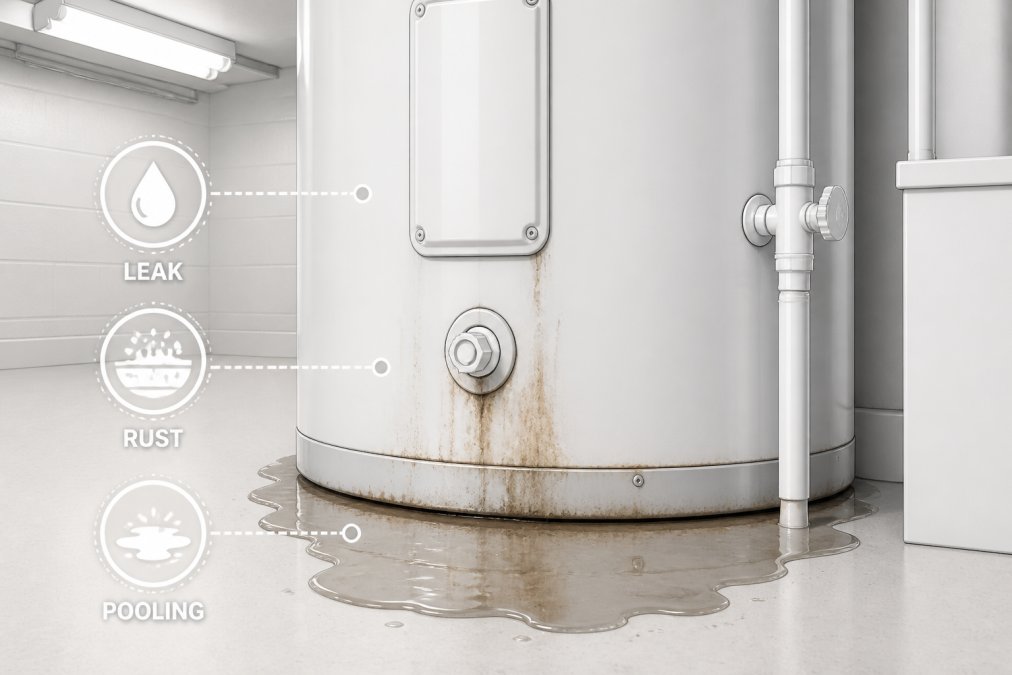
Close-up of water pooling at the base of a residential water heater tank in a utility room, showing rust stains and moisture on the floor, under harsh fluorescent lighting Safety Protocols When You Suspect a Leak
The biggest mistake people make is continuing to use hot water while investigating a suspected leak. Here’s the correct sequence:
- Turn off the cold water supply valve feeding the heater (typically located directly above the unit)
- For a gas water heater, switch the thermostat to "Pilot", do not shut off the gas line unless you smell gas
- For an electric water heater, go to your breaker panel and cut power to the heater circuit
- If you smell gas at any point, leave the building immediately and call your gas utility provider before calling a plumber
- Do not attempt to drain the tank yourself unless you are certain the unit is fully powered down and cooled
Watch Out
If you smell sulfur or rotten eggs near your water heater, this indicates a potential gas leak. Do not flip any switches, use your phone inside the building, or attempt repairs. Exit immediately and call 911 and your gas utility from outside.Water Heater Troubleshooting Guide: What to Check First
Not every hot water problem is an emergency. A structured troubleshooting approach can save you a service call, or confirm you genuinely need one.
Gas Water Heater: Pilot Light and Thermocouple Checks
The most common reason a gas water heater stops producing hot water is a failed pilot light. Check whether the pilot is lit by looking through the viewing window at the base of the unit. If the pilot is out, follow the manufacturer’s relight instructions printed on the unit’s label. If it won’t stay lit after three attempts, the thermocouple is the likely culprit. This small sensor detects whether the pilot flame is burning and signals the gas valve to stay open. A worn thermocouple is inexpensive to replace but requires a licensed plumber to do safely.
Also check the gas supply valve (confirm it’s fully open), the thermostat setting (minimum 120°F for safe hot water supply), and whether the unit has a recent error code displayed on the control panel.
Electric Water Heater: Heating Element and Breaker Checks
For an electric water heater, start at the breaker panel. A tripped breaker is the most common cause of no hot water. Reset it once. If it trips again immediately, stop, there’s an electrical fault that needs professional diagnosis.
If the breaker holds, the issue is likely a failed heating element. Most electric tanks have two elements: upper and lower. A failed upper element means no hot water at all. A failed lower element means you get a small amount of hot water that runs out quickly. Check the thermostat reset button behind the access panel on the side of the tank. Press it firmly. If it clicks and hot water returns within an hour, you’ve found your fix. If it trips again, the element has likely shorted.
Tankless Water Heater: Common Error Codes
Tankless water heaters display error codes directly on the unit. Common issues include no ignition errors (caused by gas supply interruption or a failed igniter), overheating codes (triggered by scale buildup from hard water sediment), flow sensor errors (indicating debris in the inlet filter), and venting errors (signaling a blocked exhaust vent).
For tankless units, clearing the inlet filter is a legitimate DIY step. Everything else, especially anything involving the gas line, igniter, or heat exchanger, requires a licensed professional.
Pro Tip
Hard water sediment buildup is the number one cause of premature tankless water heater failure. Flushing the system with a descaling solution annually can extend the unit’s lifespan significantly.When to Call an Emergency Water Heater Repair Service
Some problems can wait for a scheduled appointment. Others cannot.
Situations That Cannot Wait Until Morning
Call an emergency water heater repair service immediately if you encounter any of the following:
- Active water leaking from the tank body (not just fittings or valves), indicating the tank wall has failed
- Any gas smell near the unit, treat this as a gas emergency
- The pressure relief valve is discharging continuously, meaning pressure inside the tank is dangerously high
- Complete loss of hot water in a home with young children, elderly residents, or medical needs
- Water damage already spreading to walls, flooring, or adjacent rooms
- Unusual sounds: banging, rumbling, or popping that started suddenly
A common mistake is waiting until business hours to avoid after-hours fees. In most cases, the water damage that accumulates overnight costs far more than the dispatch fee.
Water Heater Lifespan Indicators: Repair or Replace?
A standard tank water heater has a typical service life of 8 to 12 years. A tankless unit generally lasts longer, often 15 to 20 years with proper maintenance, according to U.S. Department of Energy water heater efficiency and lifespan data.
Use this framework when deciding whether to repair or replace:
Indicator Lean Toward Repair Lean Toward Replacement Unit age Under 8 years 10+ years Repair cost vs. new unit Under 40% of replacement cost Over 50% of replacement cost Rust in hot water No Yes Frequency of repairs First or second issue Third+ repair in 2 years Energy bills Stable Steadily increasing Sediment buildup Minor, recently flushed Heavy, recurring If your unit is over 10 years old and showing any two of the replacement indicators above, a new installation is almost always the more economical long-term choice.
Key Takeaway
A water heater older than 10 years showing rust-colored water or recurring failures is almost always more cost-effective to replace than repair.Average Cost of Water Heater Repair: What Affects Your Bill
The average cost of water heater repair varies considerably based on the type of repair, the unit type, and when you call.
Factors that affect repair cost:
- Type of repair: Replacing a thermocouple on a gas heater is minor. Replacing a heating element on an electric unit is moderate. Full tank replacement is the highest-cost scenario.
- Unit type: Tankless water heater repairs generally cost more than tank unit repairs due to component complexity.
- Time of call: After-hours service, weekend calls, and holiday emergency dispatch typically carry a higher service call fee.
- Parts availability: Some tankless units use proprietary components that take longer to source.
- Extent of water damage: If the leak has affected surrounding structure, flooring, or drywall, remediation costs are separate from the plumbing repair.
For specific pricing on any repair or replacement, contact PUR Plumbing directly for a straightforward quote. As noted in the ENERGY STAR guide to water heater replacement decisions, the total cost of ownership, including energy efficiency, should factor into any repair versus replacement decision.
How Our Emergency Water Heater Repair Service Works
PUR Plumbing’s emergency water heater repair service is built around one principle: you shouldn’t have to manage a plumbing crisis alone at 11 PM.
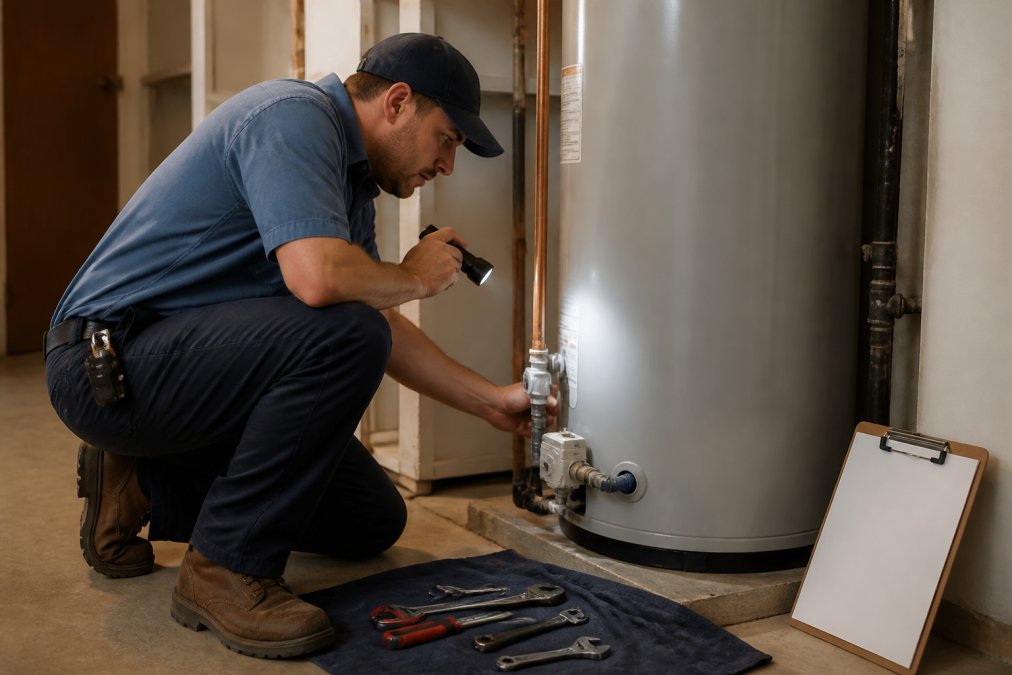
A licensed plumber in uniform crouching beside a residential water heater tank in a utility room, inspecting connections with a flashlight, tools laid out on a cloth nearby and a clipboard resting against the wall Step 1: Call or Contact Us Any Time of Day
Reach out by phone or through our contact form. When you call, have the following ready to speed up dispatch: the type of unit (tank or tankless, gas or electric), the brand and model number if visible, a brief description of the problem, and whether the unit is already powered down.
Step 2: Emergency Dispatch and Same-Day Service
After-hours service and same-day service are available for genuine emergencies. Our vehicles are fully stocked with the most common repair parts for both tank and tankless water heaters, gas and electric, which means most repairs can be completed on the first visit rather than requiring a return trip for parts.
Step 3: Diagnosis, Repair, or Replacement on the Spot
The technician will diagnose the unit, explain the findings clearly, and present options before any work begins. If the repair is straightforward, it’s typically handled the same visit. If the unit needs full replacement, the technician will walk you through tank versus tankless options and help you make the right call for your home and budget.
Licensed and Insured Professionals You Can Trust
Licensing matters more in plumbing than in almost any other trade. An unlicensed repair on a gas water heater can void your homeowner’s insurance and create liability issues.
PUR Plumbing holds license CFC 1427929 and is fully insured for both residential and commercial work. That’s verifiable, not just a claim. Beyond licensing, experience is what separates a plumber who can replace a part from one who can accurately diagnose why the part failed in the first place. According to the Plumbing-Heating-Cooling Contractors Association on licensing standards, licensed plumbers must meet state-mandated training and examination requirements that ensure both technical competency and code compliance.
PUR Plumbing has been serving Pasco County for over 25 years. That tenure in a single market means the team knows local water conditions, the most common failure patterns for equipment in this region, and which solutions hold up over time.
Frequently Asked Questions
Is a water heater not working considered a plumbing emergency?
A complete loss of hot water is disruptive but not always dangerous on its own. However, certain conditions make it a true plumbing emergency: active leaks causing water damage, a gas water heater with a suspected gas leak, a failed pressure relief valve, or a unit showing signs of overheating. In those cases, shut off the water supply and gas or power to the unit immediately and call an emergency water heater repair service rather than waiting for a scheduled appointment.
What are the signs that my water heater needs immediate repair?
Watch for water pooling around the base of the tank, a pressure relief valve that is dripping or discharging, discolored or foul-smelling hot water, loud popping or rumbling sounds caused by sediment buildup, and a pilot light that will not stay lit on a gas water heater. Any of these signs point to a problem that will worsen quickly. An electric water heater with a tripped breaker that keeps resetting also warrants a same-day service call.
How long does an emergency water heater repair typically take?
Most emergency repairs, such as replacing a thermocouple, heating element, or anode rod, take one to two hours once the technician arrives. A full water heater replacement generally takes two to four hours depending on the unit type and installation complexity. Tankless water heater installations can run longer. A fully stocked service vehicle helps avoid delays from parts runs, which is why same-day resolution is realistic in most residential cases.
How much does emergency water heater repair cost?
The average cost of water heater repair varies based on the part that has failed, whether it is a gas or electric unit, and whether after-hours service applies. Minor fixes like a thermocouple or pilot light repair cost less than a full heating element replacement or a new tank installation. Because pricing depends on diagnosis, it is best to contact a licensed plumber for an accurate quote rather than relying on general estimates that may not reflect your specific situation.
A water heater failure is stressful, especially when it happens outside business hours. PUR Plumbing provides emergency water heater repair service around the clock, backed by 25+ years of local experience, fully stocked vehicles for same-day repairs, and a licensed team that gives you straight answers before touching anything. Whether you need a quick thermocouple swap or a full tankless water heater installation, contact PUR Plumbing and get the problem resolved the right way, the first time.
This article was written using GrandRanker
CALL 727-475-1474 and 813-579-1920


CFC 1427929
Serving Pasco County 25+ Years
info@purplumbing.com
Emergency Water Heater Repair Service: 2026 Guide
August 21, 2026 | Blog
- Reageer
For more information or to request an appointment dial 727-475-1474 and 813-579-1920
Serving Pasco County 25+ Years, info@purplumbing.com
Carrollwood
Clearwater
Dunedin
Holiday
Land O Lakes
Lutz
New Port Richey
Oldsmar
Palm Harbor
Plant City
Saint Petersburg
Tampa
Tarpon Springs
Temple Terrace
Town N Country
Trinity
West Chase
Site Designed by GoProLocal