Table of Contents
- 8 Signs Your Water Heater Needs Replacing
- Average Water Heater Lifespan by Type
- Repair vs. Replace: How to Make the Call
- Understanding Water Heater Replacement Cost
- DIY Inspection Checklist and Warranty Verification
- Water Heater Maintenance Tips to Extend Its Life
- Conclusion
Last Updated: August 17, 2026
8 Signs Your Water Heater Needs Replacing
Knowing the signs your water heater needs replacing can save you from a flooded utility room, sky-high energy bills, or a cold shower at the worst time. Water heaters rarely fail without warning, they give you signals for months before quitting entirely.
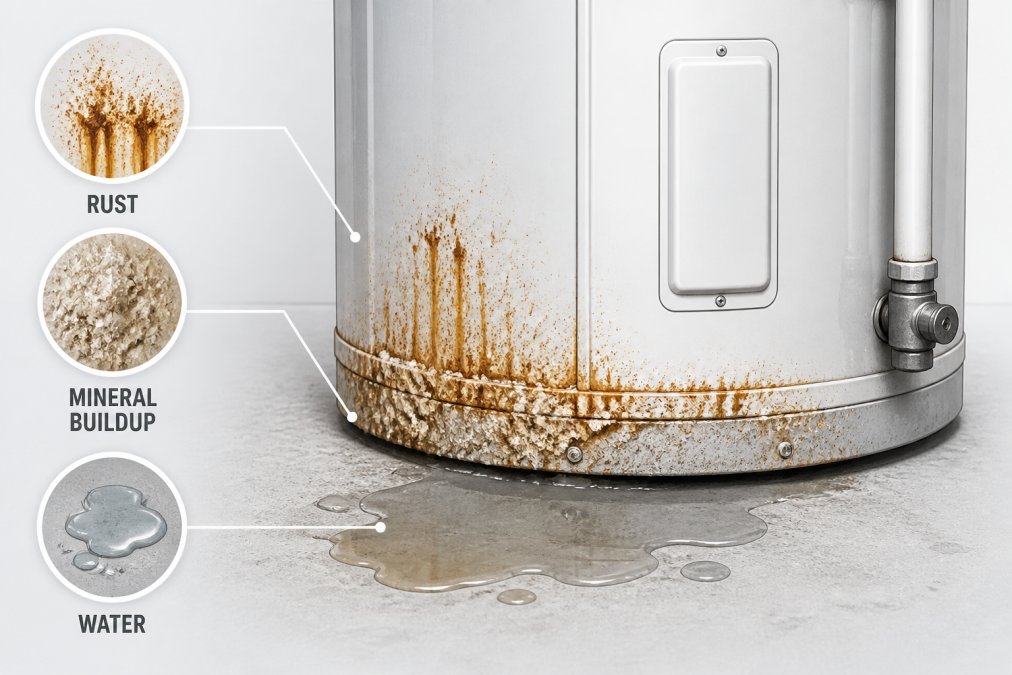
Close-up of a corroded residential water heater tank showing rust stains and mineral scale buildup around the base, with a small puddle of water on the concrete floor beneath it Here are the eight clearest signs it’s time to replace yours.
1. Age Beyond Its Service Life
Most storage tank units have a service life of 8 to 12 years, though some last up to 15 years with maintenance. Tankless water heaters generally outlast tank models, often running 20 years or more.
To find your unit’s age, locate the serial number on the manufacturer’s label. The date code is typically in the first few characters. If your unit is pushing or past the 10-year mark, start planning for replacement now, even if it seems to be running fine.
2. Rust-Colored or Discolored Water
Rust-colored water from your hot tap means corrosion is occurring inside the tank. The anode rod, a sacrificial metal rod designed to attract corrosive elements before they attack the tank, may have depleted completely. If discoloration appears only on the hot side, the tank is almost certainly the source. This sign alone warrants an immediate inspection.
3. Knocking, Popping, or Rumbling Noises
Knocking and popping noises are caused by sediment buildup at the tank bottom. When the heating element fires, it pushes through that layer of scale, creating distinctive sounds. Heavy sediment buildup forces the unit to work harder, reduces efficiency, and accelerates wear. Once noises become persistent, the damage is often already done.
4. Visible Leaks or Puddles Around the Tank
Leaking water around the base is never normal. Small puddles can indicate a failing pressure relief valve, a loose connection, or a crack in the tank itself. Thermal expansion cycles cause metal to contract and expand over years, eventually creating fractures that no repair can fix permanently. If you spot puddles, shut off the cold water supply and call a licensed plumber the same day.
5. Inconsistent Water Temperature
Temperature fluctuations point to a failing thermostat, a deteriorating heating element, or sediment insulating the heat sensor. On gas units, a faulty thermocouple or pilot light issue can cause similar instability. Frequent, unpredictable fluctuations in an older unit usually signal that the system is failing across multiple points.
6. Reduced Hot Water Output
If your hot water supply runs out faster than it used to, sediment accumulation is displacing water volume inside the tank. A partially failed heating element produces the same result: the unit heats less water, more slowly. This is common in units more than eight years old, and the fix is usually replacement.
7. Frequent Repairs Adding Up
One repair every few years is normal. Two or three repairs in a single year is a pattern that doesn’t reverse. When cumulative repair costs approach half the price of a new unit, replacement almost always makes more economic sense. A new unit also comes with a manufacturer’s warranty.
8. Rising Energy Bills Without Explanation
As sediment accumulates and components wear, the unit consumes more energy to deliver the same hot water. If your gas or electric bills have crept up without explanation, your water heater’s declining efficiency may be the culprit. According to the U.S. Department of Energy water heating guidance, water heating accounts for roughly 18% of a home’s total energy use.
Average Water Heater Lifespan by Type
Understanding average water heater lifespan by type helps you plan replacement on your terms rather than in crisis mode.
Water Heater Type Average Lifespan Key Maintenance Factor Storage tank (gas) 8-12 years Annual anode rod inspection Storage tank (electric) 10-15 years Periodic sediment flushing Tankless (gas) 18-20+ years Annual descaling Tankless (electric) 15-20 years Filter cleaning, descaling Heat pump water heater 10-15 years Air filter maintenance Units in areas with hard water often fall at the lower end of these ranges. Neglected units can fail years ahead of schedule.
Repair vs. Replace: How to Make the Call
The repair-versus-replace decision depends on three factors: the unit’s age relative to its expected service life, the repair cost relative to replacement, and whether the current unit meets your household’s hot water demand.
A useful rule: if the unit is more than halfway through its expected lifespan AND the repair costs more than one-third of a new unit’s installed price, replacement is almost always the better call. Repairs on aging units tend to cascade.
Watch Out
Never ignore a leaking pressure relief valve. This valve is a safety device that prevents dangerous pressure buildup inside the tank. A failed valve is a safety hazard requiring immediate attention.Energy Efficiency ROI: When a New Unit Pays for Itself
A water heater a decade old operates at a fraction of the efficiency of a modern unit. Current high-efficiency models, including heat pump water heaters, can cut water heating energy consumption substantially, as noted in guidance from the ENERGY STAR program.
If a new unit reduces your monthly water heating cost, that savings accumulates toward offsetting the replacement cost over a few years. Factor that into the decision alongside repair costs, and replacement often wins faster than it appears.
Tankless vs. Storage Tank: Which Makes Sense for You
Switching from a storage tank to a tankless water heater is worth considering at replacement time. Tankless units heat water on demand, eliminating standby heat loss entirely. They also last significantly longer than tank models.
The trade-off is upfront cost. For households with high hot water demand or limited space, the long-term efficiency and elimination of tank failure risk often justify that investment. PUR Plumbing offers tankless water heater installation as part of its residential service lineup.
Pro Tip
If you’re switching from a storage tank to a tankless unit, confirm that your gas line or electrical panel can support the new unit’s demand before purchase. Tankless systems often require a larger gas supply line or a panel upgrade.Understanding Water Heater Replacement Cost
Water heater replacement cost varies based on unit type, fuel source, installation complexity, and local labor rates. Factors that affect total cost include unit type and capacity, whether existing connections need modification, permit requirements, disposal of the old unit, and any code upgrades required.
For current pricing, get a direct quote from a licensed plumber who can assess your specific setup. Contact PUR Plumbing for a straightforward quote with no guesswork.
DIY Inspection Checklist and Warranty Verification
A basic DIY inspection takes about 15 minutes. Run through this checklist every six months:
- Check the area around the base for moisture, rust stains, or active puddles
- Listen for knocking, popping, or rumbling during a heating cycle
- Run hot water and observe color; clear is normal, rust-colored or cloudy is not
- Test the pressure relief valve by briefly lifting the lever (ensure a drain line is in place first)
- Inspect visible pipes and connections for corrosion or mineral deposits
- Check the temperature setting; 120°F is the recommended safe setting per guidance from the Consumer Product Safety Commission
- Note the unit’s age using the serial number date code
If you find issues with more than two items on this list, call a licensed plumber.
How to Check Your Warranty Status
Most storage tank water heaters carry a manufacturer’s warranty of 6 to 12 years on the tank itself. If your unit is still within that window and the tank has failed, you may be entitled to a prorated replacement at no cost.
To verify warranty status:
- Locate the model and serial number on the unit’s label
- Visit the manufacturer’s website and use their warranty lookup tool, or call customer support
- Have your purchase or installation date available
- Ask your plumber to confirm warranty applicability before authorizing a paid replacement
Water Heater Maintenance Tips to Extend Its Life
Regular maintenance is the most effective way to push your water heater toward the upper end of its expected service life.
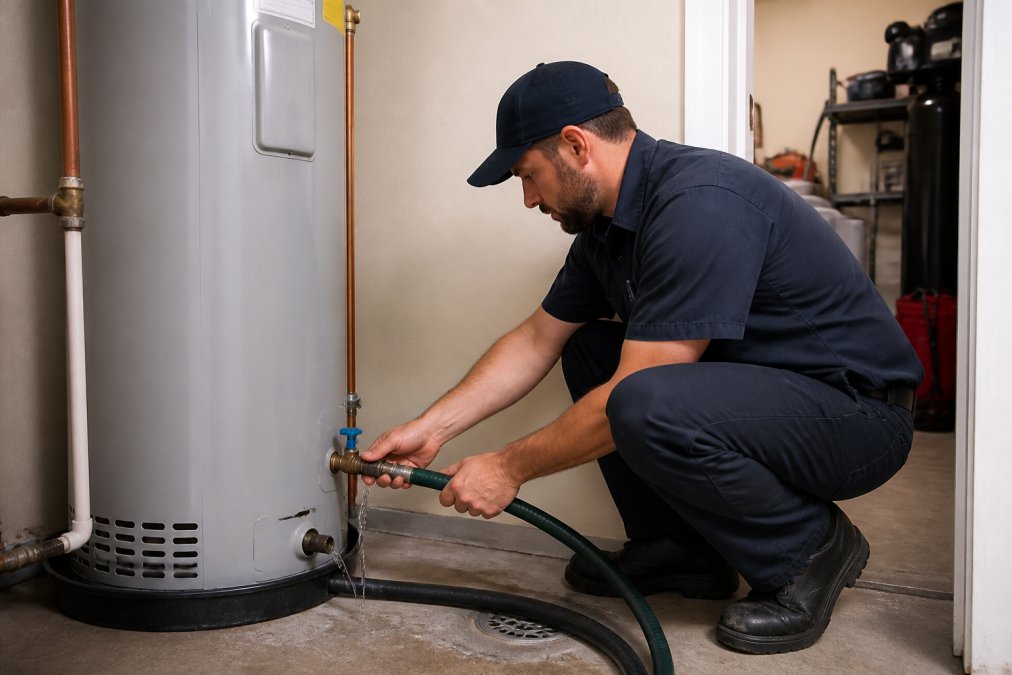
A licensed plumber in uniform crouching beside a water heater, attaching a hose to the drain valve to flush sediment from the tank in a residential utility room with overhead fluorescent lighting Flush the tank annually. Sediment buildup is the primary cause of premature failure. Attaching a garden hose to the drain valve and flushing until the water runs clear removes accumulated scale and extends the heating element’s life.
Inspect and replace the anode rod every 3 to 5 years. The anode rod corrodes so the tank doesn’t. Once depleted, the tank itself begins to corrode. Replacing it is inexpensive and extends tank life significantly.
Check the pressure relief valve annually. This safety device prevents dangerous pressure buildup. A valve that doesn’t release and reseat properly needs immediate replacement.
Insulate the first few feet of hot and cold water pipes. Pipe insulation reduces standby heat loss and improves delivery efficiency, particularly in unconditioned spaces.
Set the thermostat correctly. 120°F is the standard recommended setting. Higher temperatures accelerate sediment formation and increase scalding risk.
Key Takeaway
The single most impactful maintenance task is annual sediment flushing. Most water heater failures involve sediment-related damage that could have been slowed or prevented with this one step.Maintenance matters most in areas with hard water. If your area has high water hardness, consider having a licensed plumber inspect the unit annually.
Recognizing the signs your water heater needs replacing before a failure occurs gives you time to make a deliberate decision rather than an emergency one. PUR Plumbing has served Pasco County homeowners and commercial property owners for more than 25 years, with fully equipped vehicles and licensed technicians ready to assess, repair, or replace your water heater efficiently. Whether you’re weighing a like-for-like tank replacement or considering the switch to a tankless system, contact PUR Plumbing for an honest evaluation and a straightforward quote.
Frequently Asked Questions
What is the average lifespan of a home water heater?
A conventional storage tank water heater typically lasts 8 to 12 years. Tankless water heaters have a longer service life, often reaching 15 to 20 years with proper maintenance. Hard water, heavy daily use, and skipped maintenance can shorten either type's lifespan. Check the serial number on your unit's label, most manufacturers encode the manufacture date in the first few characters, which tells you exactly how old your water heater is.
What are the first signs of a water heater going bad?
The earliest warning signs your water heater needs replacing include lukewarm water that used to run hot, rust-colored or metallic-smelling water at the hot tap, and knocking or popping sounds during heating cycles. Those noises usually point to heavy sediment buildup at the bottom of the tank. A unit showing two or more of these symptoms simultaneously, especially one over 10 years old, is signaling it's near the end of its service life.
Can a leaking water heater be repaired or does it need replacement?
It depends on where the leak originates. A dripping pressure relief valve or a loose fitting can often be repaired affordably. However, a leak coming from the tank body itself almost always means the interior has corroded through, and that requires full replacement. Patching a corroded storage tank is not a lasting fix. If you see water pooling directly beneath the tank, shut off the cold water supply and call a licensed plumber to assess it before the situation worsens.
How much does water heater replacement cost?
Replacement cost varies based on unit type, tank capacity, fuel source, and local labor rates. Tankless water heaters generally cost more upfront than conventional storage tank models but can reduce energy bills over time. Because every installation is different, get a written quote from a licensed plumber before committing. A reputable plumber will assess your existing setup, venting, and fuel connections before giving you an accurate number.
This article was written using GrandRanker
CALL 727-475-1474 and 813-579-1920


CFC 1427929
Serving Pasco County 25+ Years
info@purplumbing.com
Signs Your Water Heater Needs Replacing: 2026 Guide
August 21, 2026 | Blog
- Reageer
For more information or to request an appointment dial 727-475-1474 and 813-579-1920
Serving Pasco County 25+ Years, info@purplumbing.com
Carrollwood
Clearwater
Dunedin
Holiday
Land O Lakes
Lutz
New Port Richey
Oldsmar
Palm Harbor
Plant City
Saint Petersburg
Tampa
Tarpon Springs
Temple Terrace
Town N Country
Trinity
West Chase
Site Designed by GoProLocal