Table of Contents
- Start Here: The 10-Minute Diagnostic for a Toilet That Runs Intermittently
- Why Your Toilet Randomly Runs for a Few Seconds
- Toilet Flapper Leaking: How to Confirm and Fix It
- Toilet Fill Valve Problems That Cause Intermittent Running
- Toilet Running After Replacing Flapper: What to Check Next
- When to Call a Plumber for a Toilet That Runs Intermittently
- Prevention and Follow-Up Checks
- Conclusion
- Frequently Asked Questions
Last Updated: October 5, 2026
Start Here: The 10-Minute Diagnostic for a Toilet That Runs Intermittently
When a toilet runs intermittently, it is almost always a tank-side problem you can narrow down in about ten minutes.

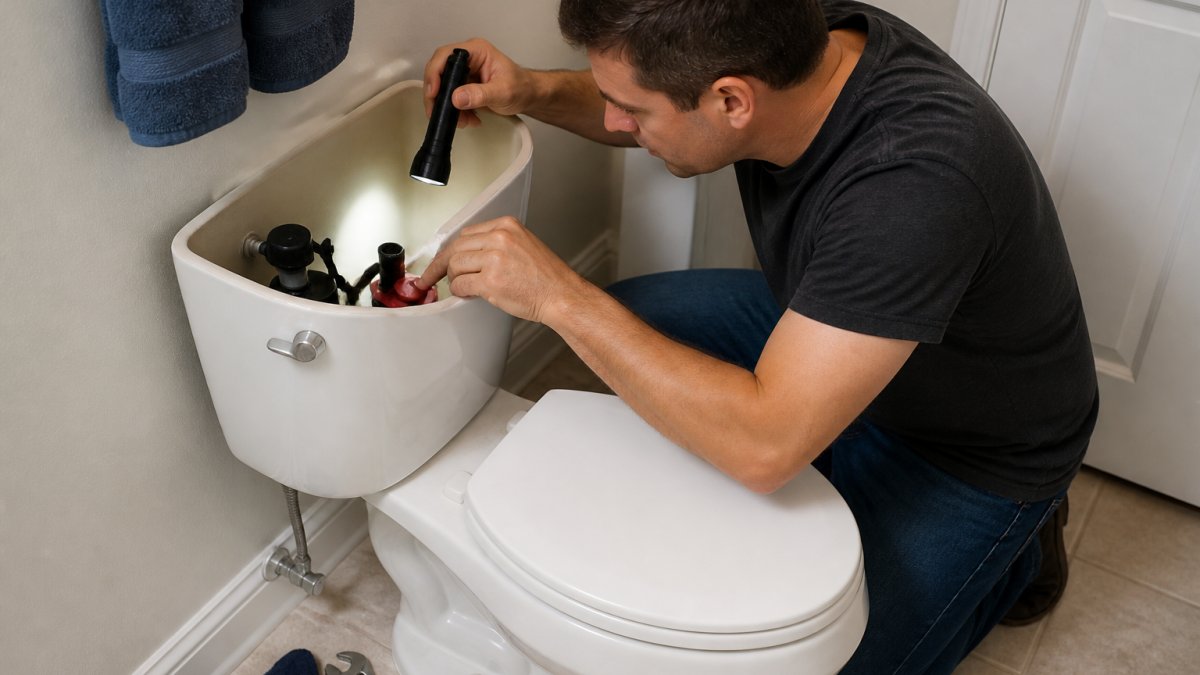
A homeowner kneeling beside a toilet with the tank lid off, holding a flashlight and inspecting the flapper and fill valve inside the tank, with a wrench and rag on the floor nearby Most cases trace back to a flapper, a fill valve, or a water level set too high. The steps below find the cause.
What You’ll Need
- A flashlight
- A rag or towel
- Food coloring or a dye tablet
Why Your Toilet Randomly Runs for a Few Seconds
A toilet randomly runs for a few seconds when water slowly leaks out of the tank, drops the level below the fill line, and triggers the fill valve to refill. Once the tank tops off, the cycle repeats, which is why the running seems random instead of constant. Two quick tests confirm it.
The Water Level Test
Mark the water line in the tank with a pencil and wait 20 to 30 minutes without flushing. If the line drops, water is escaping below; if it stays put, check the fill valve or water level setting.
The Dye Test
Add food coloring or a dye tablet to the tank water, wait 15 minutes without flushing, then check the bowl. Color means the flapper or flush valve seal is leaking; no color means the seal holds, so check the fill valve instead.
Pro Tip
Run the dye test at night before bed. A slow leak that shows nothing in 15 minutes often shows clear color by morning, which saves you a second trip to the hardware store.Toilet Flapper Leaking: How to Confirm and Fix It
A leaking toilet flapper is the number one reason a toilet runs intermittently. The flapper is the rubber seal that drops after a flush; over time it warps, hardens, or collects mineral buildup and stops sealing.
Look for these signs:
- The flapper looks warped, cracked, or covered in slime
- The chain is too tight or tangled under the flapper
- The flapper seat feels rough or gritty
Any of these means replacement is the fix, a new flapper is cheap and installs in minutes.
How to Replace the Flapper
- Shut off the water supply at the shutoff valve behind the toilet.
- Flush to empty the tank, then sponge out the leftover water.
- Unhook the old flapper from the overflow tube and lever arm.
- Take the old flapper to the store to match the brand and size.
- Clip the new flapper onto the overflow tube and hook up the chain.
- Leave about half an inch of slack in the chain.
- Turn the water back on and flush twice to test.
If the running stops, you are done. If it continues, move to the next section.
Toilet Fill Valve Problems That Cause Intermittent Running
Toilet fill valve problems cause intermittent running when the valve never fully shuts off or the water level sits too high. A misadjusted, sediment-clogged, or worn valve lets water trickle into the overflow tube, and the toilet keeps refilling in short bursts.
Check these three things:
- Water level too high: The water should sit about an inch below the top of the overflow tube. If it is at or above the tube, water spills in and drains away.
- Float or float cup: A float that sits too high keeps the valve open. Bend the float arm down or turn the adjustment screw to lower it.
- Sediment in the valve: Hard water leaves grit that stops the valve from sealing. A rebuild kit or a full replacement solves it.
How to Adjust or Replace the Fill Valve
- Turn off the water supply and flush the tank.
- For an adjustment, turn the screw or slide the float cup down until the water line drops.
- To replace, unscrew the supply line and the lock nut under the tank.
- Lift out the old valve and set the new one to the same height.
- Reconnect the supply line, turn the water on, and check the new fill line.
- Adjust until the water sits an inch below the overflow tube.
Watch Out
Do not set the water level above the overflow tube to “get a stronger flush.” The extra water just drains into the bowl and down the drain, and your water bill climbs every month.Toilet Running After Replacing Flapper: What to Check Next
If the toilet still runs after you have replaced the flapper, the problem is almost always one of three things: the new flapper is not sealing, the flush valve seat is worn, or your toilet does not use a flapper at all. That last point trips up many homeowners, because not every toilet has a rubber flapper hanging from a chain.
Step 1: Confirm the New Flapper Is Actually Sealing
Before buying another part, rule out an installation error:
- Chain tension: The chain should have about half an inch of slack. Pulled tight, it holds the flapper slightly open and the tank drains continuously; too loose, it can get caught under the flapper and prop it up.
- Flapper alignment: The flapper must sit flat and centered on the valve seat. A twisted or off-center flapper will leak even when it looks closed.
- Correct part: Flappers are not universal. A 2-inch flapper will not seal a 3-inch flush valve opening, and a flapper designed for one brand’s overflow tube may not clip securely onto another. Match the brand, opening size, and shape.
If all four check out and the dye test still shows color in the bowl, move on.
Step 2: Identify Your Flush Valve Mechanism
This is the step most guides skip. Toilets use one of three main flush mechanisms, each with a different replacement part. Lift the tank lid and look where water exits into the bowl.
- Standard flapper: A flat or slightly curved rubber disc on a hinge, connected to the handle by a chain or plastic arm, the most common design in older and mid-range toilets. Replacement is a flapper, matched by size and brand.
- Canister flush valve: A tall plastic cylinder that rises and drops straight down over a seal at the bottom of the tank, with no chain or hinged flapper. The wear part is the canister seal (a rubber gasket at the base), not a flapper. Some canisters are sold as a complete assembly; others let you replace just the seal. Match the canister to the toilet brand and model, because dimensions vary.
- Tower or 3-inch flush valve: A taller, wider valve body with a large seal at the base, common on newer high-efficiency toilets. The seal is a ring or gasket under the tower, usually brand-specific.
Step 3: Match the Replacement Part to the Toilet
The fastest way to get the right part is to find the manufacturer and model stamped inside the tank or on the back of the bowl near the seat hinge, and write it down before you go to the store.
A common pattern: a homeowner replaces a flapper on a toilet that actually uses a canister, the running continues, and they assume the repair failed. It did not, the wrong part was replaced.
Step 4: Test the Fill Valve Shutoff
If the flush valve mechanism is confirmed good, check whether the fill valve shuts off completely. Mark the water line, wait 30 minutes without flushing, and look again. If the level is steady but you still hear water, the fill valve is passing water into the overflow tube, an adjustment or replacement, covered above.
Pro Tip
Snap a photo of the inside of your tank before you remove anything. Reassembly is much easier when you can see how the chain, flapper, and refill tube were positioned originally.Once you have confirmed the mechanism type and replaced the correct wear part, flush five or six times and listen. The tank should fill once and go quiet. If it kicks on again within a few minutes, repeat the dye test.
When to Call a Plumber for a Toilet That Runs Intermittently
Most intermittent-running repairs are DIY-friendly, but some situations call for a licensed plumber. Knowing the difference saves money and frustration.
Repairs You Can Handle Yourself
These beginner-level jobs need only basic tools and typically take 15 to 45 minutes:
- Replacing a flapper or canister seal
- Adjusting the water level on a fill valve
- Cleaning mineral buildup off the flush valve seat
When to Call a Plumber
Call a professional when any of these apply:
- The shutoff valve is stuck, seized, or leaking. Forcing a stuck valve can break it and cause a flood. A plumber can replace it.
- The tank or bowl is cracked. Cracks cannot be repaired safely. The toilet needs replacement.
- The toilet rocks, or the flange is loose. A loose flange can leak under the floor and rot the subfloor. This is a bigger repair than it looks.
Realistic Cost Ranges
Part costs are low: a standard flapper runs a few dollars, a fill valve is usually $10 to $20, and a canister or tower seal is often $10 to $25, depending on brand. Labor is where the cost adds up, a plumber’s service call for a running toilet can vary depending on the complexity of the repair and whether parts are included.
Repair vs. Replace: How to Decide
Use these criteria:
- Age of the toilet: If it is more than 15 to 20 years old and you have already replaced multiple internal parts, replacement is often the better long-term value.
- Water efficiency: Older toilets can use 3.5 gallons or more per flush. Modern high-efficiency models use 1.28 gallons or less, which lowers your water bill every month.
- Number of failed repairs: If you have replaced the flapper, fill valve, and flush valve seal and the toilet still runs, the remaining repair may cost more than a basic new toilet.
Watch Out
Do not ignore a running toilet because the repair seems small. A toilet that runs intermittently can waste dozens of gallons per day, and that shows up on every water bill until it is fixed.What to Have Ready Before the Plumber Arrives
To make the visit faster and cheaper, have the toilet’s brand and model number written down, note any parts you have already replaced, clear the area around the toilet, and share your dye test result.
Prevention and Follow-Up Checks
Prevention comes down to a few habits. Check your tank twice a year to catch most problems before they turn into a running toilet.
- Run the dye test every six months
- Wipe mineral buildup off the flapper and seat
- Check the chain tension after every few months
After any repair, flush five or six times and listen. The tank should fill once and go quiet; if it kicks on again within a few minutes, something is still leaking.
Conclusion
A toilet that runs intermittently is annoying, but rarely a mystery. Nine times out of ten, the cause is a leaking flapper, a fill valve that needs adjusting, or a water level set too high. The dye test and water level test tell you which one in minutes.
Frequently Asked Questions
What would cause a toilet to run occasionally?
A toilet that runs occasionally usually has a slow leak past the flapper or a water level set too high. When the flapper seal wears out, water seeps into the bowl and the fill valve kicks on every few minutes to refill the tank. A water level above the overflow tube causes the same symptom. Run a dye test: add food coloring to the tank, wait 15 minutes without flushing, and check the bowl. Colored water means the flapper is leaking.
Why does my toilet randomly run, then stop, and then run again?
That cycle points to a tank-to-bowl leak. Water escapes past the flapper or canister seal, the water level drops below the fill line, and the fill valve refills the tank. Once the level resets, the valve shuts off until enough water leaks out again. A worn flapper, a warped flush valve seal, or a mineral-crusted flapper seat are the usual culprits. Replacing the flapper and cleaning the seat stops the cycle.
My toilet flapper has been replaced, but the water still runs intermittently. What could be causing this?
If a new flapper did not fix it, check three things. First, the flapper chain may be too tight and holding the flapper slightly open. Second, the flapper seat on the flush valve may be rough or mineral-crusted, so the new rubber cannot seal. Third, the fill valve may be failing and letting water trickle into the overflow tube. Adjust the chain, clean or replace the flush valve seal, and test the fill valve shutoff.
Can a faulty fill valve make a toilet run intermittently?
Yes. A fill valve with a worn float or a failing internal seal can let water trickle into the tank after it should have shut off. That extra water raises the level until it spills into the overflow tube, and the cycle repeats. To test it, lift the float by hand. If the water stops, the valve is working. If it keeps running, replace the fill valve. The part is inexpensive and the swap takes about 30 minutes.
If you have worked through the flapper, the fill valve, and the canister seal and the toilet still runs, it is time to bring in help. PUR Plumbing has served Pasco County for more than 25 years as a Florida family owned and operated business, with licensed residential and commercial plumbers and fully loaded vehicles for quick repairs. We handle everything from a single running toilet to full fixture installation. Contact PUR Plumbing and get your water bill back under control.
CALL 727-475-1474 and 813-579-1920


CFC 1427929
Serving Pasco County 25+ Years
info@purplumbing.com
Toilet Runs Intermittently? Fix It Fast
October 5, 2026 | Blog
- Reageer
For more information or to request an appointment dial 727-475-1474 and 813-579-1920
Serving Pasco County 25+ Years, info@purplumbing.com
Carrollwood
Clearwater
Dunedin
Holiday
Land O Lakes
Lutz
New Port Richey
Oldsmar
Palm Harbor
Plant City
Saint Petersburg
Tampa
Tarpon Springs
Temple Terrace
Town N Country
Trinity
West Chase
Site Designed by GoProLocal