Table of Contents
- Why Large Homes Break Standard Tankless Advice
- Tankless Water Heater Sizing for Large Homes: The GPM Math
- Gas vs. Electric Tankless: What a Large Household Actually Needs
- Tankless Water Heater Installation Cost and Complexity
- Maintenance Requirements for Tankless Systems
- Tankless vs. Tank: TCO Over 15 Years and Efficiency Reality
- Parallel Installation and Smart Home Integration for Large Homes
- Frequently Asked Questions
Last Updated: September 26, 2026
Why Large Homes Break Standard Tankless Advice
Most tankless water heater advice is written for a two-person apartment. That is the core problem. A tankless water heater sized for a small household often fails in a large home, not because the technology is flawed, but because the sizing math was never done properly. According to the U.S. Department of Energy’s water heating guidance, tankless units heat water on demand rather than storing it, which means their performance depends entirely on matching the unit’s capacity to the home’s peak demand. A homeowner might install a mid-range unit, then discover that running two showers and a dishwasher at once produces lukewarm water. The fix isn’t a bigger tank. It’s correct sizing.
Three things separate a tankless system that works in a large home from one that disappoints:
- Flow rate capacity measured in gallons per minute (GPM)
- Groundwater temperature entering the home
- Simultaneous usage across multiple fixtures
Get these wrong and no amount of BTU input will save you. Get them right and a tankless water heater delivers endless hot water for a household of six.
Tankless Water Heater Sizing for Large Homes: The GPM Math
Tankless water heater sizing for large homes starts with adding up the flow rate of every fixture likely to run at once. A standard showerhead uses roughly 2.0 to 2.5 GPM, a kitchen faucet about 1.5 GPM, and a washing machine around 2.0 GPM. Add a second shower and you’re at 6 to 7 GPM before anything else turns on.

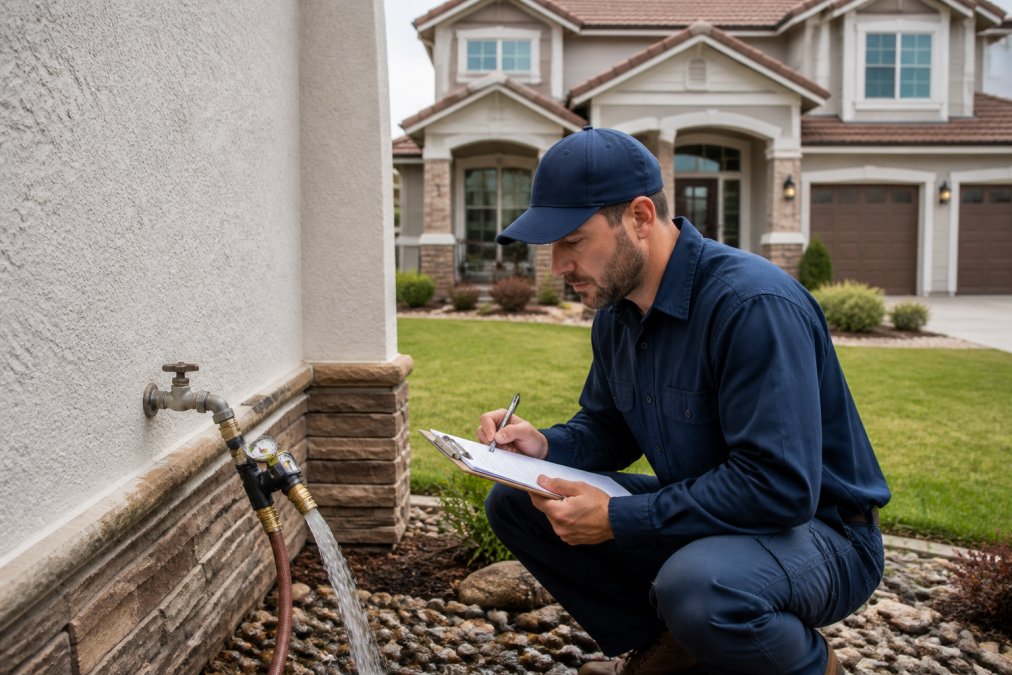
Licensed plumber using a flow meter at a home to determine tankless water heater sizing requirements Watch Out
Sizing a tankless unit by square footage or bathroom count alone is the single most common mistake. A 4,000-square-foot home with one occupant needs far less capacity than a 2,000-square-foot home with five. Always calculate GPM from actual fixtures.Groundwater Temperature and Cold Climate Derating
Groundwater temperature directly reduces a tankless unit’s effective flow rate. In northern states, incoming water can sit near 40 degrees Fahrenheit in winter, so a unit must raise it 70 to 80 degrees to reach a comfortable 120-degree output. That larger rise cuts GPM capacity significantly, the same unit delivering 9 GPM in a warm climate may manage only 5 GPM in a cold one.
Simultaneous Usage: Peak Demand in a Full House
Peak demand is the moment everything runs at once: two showers, a dishwasher, and a laundry cycle. For a large household, that moment defines the required capacity. A common approach is to size for the worst-case morning scenario rather than the average day. The American Society of Plumbing Engineers publishes fixture flow rate standards that help with these calculations.
Fixture Typical Flow Rate (GPM) Notes Standard showerhead 2.0-2.5 Per shower running Kitchen faucet 1.5 Single fixture Washing machine 2.0 Per cycle fill Dishwasher 1.5 During wash phase Bathroom faucet 1.0 Per sink When the Math Says One Unit Cannot Do It
Run the numbers for a large home and you often land on a peak demand of 8 to 12 GPM at a 70- to 80-degree rise. Few single residential tankless units can hit that in a cold climate, so the answer is to split the load, not buy bigger.
Key Takeaway
For a large home in a cold climate, the right question is not ‘which single unit is big enough’ but ‘how many units do I need in parallel to hit my peak GPM at winter groundwater temperatures.’Gas vs. Electric Tankless: What a Large Household Actually Needs
For a large home, the gas-versus-electric decision is really about how much heat you can deliver per minute. Tankless units are rated by temperature rise, and a large household running two showers plus laundry needs a big rise at a high flow rate simultaneously, that combination is where the technologies separate.
Factor Gas Tankless Electric Tankless Typical input 140,000-199,000 BTU/hr 18-36 kW Electrical demand Low (controls only) 75-150 amps at 240V Venting Required (stainless or PVC/CPVC) None Gas line Often needs upsizing Not applicable Best fit Whole-home, high simultaneous demand Point-of-use or small homes Cold-climate GPM Higher, with derating Lower, with derating A common failure pattern in large homes is installing one electric tankless unit to serve the whole house. The panel cannot support the amperage, the unit cannot keep up with simultaneous demand, and the homeowner ends up with lukewarm water at the far fixtures. If gas is available, it is usually the more practical path for whole-home coverage.
When One Unit Is Not Enough: Parallel and Cascading Installation
When a single tankless unit cannot meet peak demand, common in homes with four or more bathrooms or a large household, the standard solution is not a bigger unit but two units installed in parallel through a manifold or cascading controller.
This approach has real trade-offs:
- Higher upfront cost for the second unit, manifold, and controls
- More venting and gas line work
- Two heat exchangers to descale annually instead of one
- Requires a plumber experienced with cascading controls, not just single-unit swaps
Ask your installer whether the proposed unit can be cascaded later. Choosing a model with a built-in cascade port now means you can add a second unit if demand grows, instead of replacing the whole system.
Tankless Water Heater Installation Cost and Complexity
Tankless water heater installation cost varies widely based on the upgrades a home requires. The unit itself is only part of the picture, venting, gas line sizing, and electrical work often drive the final number higher than homeowners expect. Because pricing depends on your existing plumbing infrastructure, request a quote rather than relying on generic estimates.
Venting, Gas Line Sizing, and Electrical Upgrades
Gas tankless units require stainless steel venting with specific clearance requirements, and many homes need a larger gas line to feed the unit’s BTU demand. Electric models frequently need a dedicated 240-volt circuit and possibly a panel upgrade. These hidden costs separate a simple swap from a full installation project.
Before committing to a tankless unit, ask your installer to assess your gas meter capacity and venting path first. Discovering a needed gas line upgrade after purchase adds cost and delay. A short pre-installation assessment prevents surprises.
Maintenance Requirements for Tankless Systems
Maintenance requirements for tankless systems center on descaling. Minerals in hard water build up inside the heat exchanger, reducing thermal efficiency and eventually restricting flow. Most manufacturers recommend descaling annually, though hard water areas may need it more often.
A basic maintenance schedule includes:
- Flush the heat exchanger with a descaling solution annually
- Clean or replace the inlet water filter
- Check the venting for blockages or corrosion
- Test the pressure relief valve
- Inspect connections for leaks
Tankless vs. Tank: TCO Over 15 Years and Efficiency Reality
Over 15 years, total cost of ownership favors tankless in most large homes, but not for the reason most people assume. The savings come from eliminating standby heat loss, the energy a storage tank wastes keeping water hot around the clock, since tankless units only heat water when it’s needed.
Factor Tankless Tank Standby heat loss Minimal Continuous Lifespan Longer with maintenance Shorter Upfront cost Higher Lower Maintenance Annual descaling Minimal Endless hot water Yes, if sized right Limited by tank Parallel Installation and Smart Home Integration for Large Homes
When a single tankless unit can’t meet peak demand, plumbers can install two units in parallel through a manifold system. This splits the flow between units, doubling capacity without a single oversized heater, a practical solution for very large homes with high simultaneous usage.
Key Takeaway
For large homes, the winning setup is often two correctly sized units in parallel with smart monitoring, not one oversized unit running at its limit.Frequently Asked Questions
Why are plumbers against tankless water heaters?
Many plumbers push back on tankless for large homes because undersized units fail fast. A tankless water heater must raise incoming groundwater temperature to 120F at the flow rate the house demands. In a large home with three showers running, that can exceed 8 GPM, and most single residential units top out around 5 to 7 GPM in cold months. When sizing is wrong, homeowners blame the technology. Plumbers who install them correctly, with proper gas line sizing and venting, rarely see the same complaints.
How big of a house can a tankless water heater handle?
House size matters less than fixture count and simultaneous usage. A single whole-house tankless unit can serve a home with two to three bathrooms if peak demand stays under its GPM rating at your groundwater temperature. Homes with four or more bathrooms, multiple showers running at once, or a large soaking tub usually need a manifold system with two units installed in parallel. Sizing should start with a fixture-by-fixture GPM count, not square footage.
Do tankless water heaters provide enough hot water for multiple bathrooms?
They can, but only when sized for peak demand. Each standard shower draws roughly 2.0 to 2.5 GPM, so two showers plus a dishwasher can hit 6 GPM or more. A single tankless unit rated at 8 GPM at a 35F temperature rise may only deliver 5 GPM when groundwater drops to 50F in winter. For large homes with simultaneous usage, parallel installation of two units or a dedicated point-of-use heater for a primary bathroom solves the shortfall.
How much does your electric bill go up with a tankless water heater?
Electric tankless units draw significant power during operation, often 18 to 30 kW for whole-house models, which can spike demand charges. The trade-off is no standby heat loss, so you stop paying to keep 50 gallons hot around the clock. Actual bill impact depends on your utility rate structure, household size, and how much hot water you use. For large homes with high peak demand, a gas tankless unit usually costs less to run than electric resistance.
CALL 727-475-1474 and 813-579-1920


CFC 1427929
Serving Pasco County 25+ Years
info@purplumbing.com
Tankless Water Heater for Large Homes: Worth It in 2026?
September 27, 2026 | Blog
- Reageer
For more information or to request an appointment dial 727-475-1474 and 813-579-1920
Serving Pasco County 25+ Years, info@purplumbing.com
Carrollwood
Clearwater
Dunedin
Holiday
Land O Lakes
Lutz
New Port Richey
Oldsmar
Palm Harbor
Plant City
Saint Petersburg
Tampa
Tarpon Springs
Temple Terrace
Town N Country
Trinity
West Chase
Site Designed by GoProLocal