Table of Contents
- Residential Gas Line Installation Cost: What to Expect
- Average Cost per Foot for Gas Line Installation
- Gas Line Installation Permit Requirements
- 5 Factors That Increase Your Installation Price
- DIY Gas Line Installation Safety Risks
- Hiring a Licensed Gas Plumber: What It Costs
- Frequently Asked Questions
Last Updated: September 9, 2026
Residential Gas Line Installation Cost: What to Expect
The residential gas line installation cost is one of the most misunderstood line items in a home improvement budget, largely because a single price tag rarely tells the whole story. The final number depends on material choices, local permit fees, and the path the pipe must travel from your gas meter to the appliance. At PUR Plumbing, we’ve spent more than 25 years serving Pasco County homeowners, and we’ve seen how a clear breakdown of these variables prevents sticker shock and ensures the job is done safely.
The gas line installation cost is not a fixed number. It fluctuates based on project complexity, and a basic appliance hookup near an existing line will always cost less than a long run that requires trenching through a concrete slab. This guide breaks down the major cost drivers, materials, and safety regulations licensed professionals must follow.
Average Cost per Foot for Gas Line Installation
Homeowners researching gas line costs almost always start with a per-foot price, and for good reason: it is the most direct way to compare quotes. However, the per-foot number is a blended rate that shifts with material choice, labor rates, and the physical difficulty of the run. The cost for a complete, permitted installation varies (homeadvisor.com).
To understand what sits inside that range, it helps to separate the two main cost components:
- Material cost: Black iron pipe and CSST (corrugated stainless steel tubing) have different material costs, with CSST typically costing more upfront but requiring fewer fittings.
- Labor cost: This is where the real variance appears. A straightforward run in an open basement or crawl space might take a professional crew 4 to 6 hours, while a run through finished walls or under a slab can take 8 to 12 hours or more. Labor costs vary depending on the complexity and duration of the job.
Why Per-Foot Pricing Diminishes on Longer Runs
A common pattern in gas line pricing is that the per-foot cost drops as the total length increases. A 10-foot run might cost $20 per foot because the plumber must still pull a permit, perform a pressure test, and schedule an inspection, fixed costs that do not scale with distance. A 50-foot run might drop to $14 per foot because those fixed costs are spread across more material.
The Real Price Drivers Within a Per-Foot Quote
When you receive a per-foot estimate, ask the contractor to itemize what is included. The most reliable quotes break down the following components:
- Permit and inspection fees: Typically $50 to $300 depending on your local jurisdiction. These are non-negotiable for code-compliant work and are usually a flat fee, not a per-foot charge.
- Pressure testing: Every new gas line must be pressurized with air or nitrogen to verify there are no leaks. This is a standard part of the labor cost, but some contractors list it as a separate line item.
- Fittings and hangers: Each elbow, tee, or wall penetration adds material cost. A straight run needs few fittings; a run that turns multiple times can add to the cost of fittings.
- Trenching or boring: If the line must travel underground, trenching or boring can add to the cost, especially if the path crosses a concrete driveway or sidewalk.
Getting an Accurate Per-Foot Quote
The only way to get a reliable per-foot figure is to have a licensed plumber measure the actual path from the gas meter to the appliance. Online calculators cannot account for obstacles like a load-bearing wall, finished drywall, or an exterior wall requiring brick drilling. Provide the plumber with the appliance type, its location, and any known obstacles. A contractor who gives a firm per-foot price without asking about these details is likely quoting a best-case scenario.
Watch Out
Per-foot pricing is a planning tool, not a binding contract. Always request a written, fixed-price quote for the entire job before authorizing work. A reputable contractor will stand behind a detailed estimate that itemizes materials, labor, and permit fees.Gas Line Installation Permit Requirements
Gas line permits are not a bureaucratic nuisance, they are the primary safety mechanism that protects your home from a catastrophic failure. Every jurisdiction that enforces building codes requires a permit for new gas piping, verifying that the work meets the International Fuel Gas Code (IFGC) (iccsafe.org). Skipping the permit creates a permanent liability that can surface during a home sale inspection, an insurance claim, or worse, a gas leak.
What the Permit Process Actually Involves
The permit process typically follows a standard sequence:
- Application submission: The licensed plumber submits a permit application that describes the scope of work, the appliance being connected, and the proposed pipe size and material. Some jurisdictions require a simple form; others require a scaled drawing of the gas line route.
- Fee payment: Permit fees for residential gas line work vary by jurisdiction. This fee is a small fraction of the total installation cost, but it is mandatory.
- Plan review (for complex jobs): If the installation involves a high-BTU appliance, a new meter, or a long underground run, the building department may review the application before issuing the permit. This can add 2 to 5 business days to the timeline.
- Inspection: Once the pipe is installed but before it is connected to the appliance, the plumber schedules a rough-in inspection. The inspector verifies that the pipe size matches the appliance’s BTU load, that hangers are properly spaced, that CSST is correctly bonded and grounded, and that all connections are accessible for leak testing.
- Pressure test: The plumber pressurizes the system with air or nitrogen to a level specified by the local code, typically 10 to 15 psi for residential systems, and holds it for a set period while monitoring for pressure drop (codes.iccsafe.org). A failing test means a leak exists and must be located and repaired before the system can be approved.
- Final approval: After the pressure test passes and the inspector signs off, the plumber can connect the appliance and the gas utility can turn on the service. The permit is then closed, and the work is officially code-compliant.
Who Is Responsible for What: Utility vs. Private Contractor
One of the most common sources of confusion for homeowners is the boundary between the gas utility’s responsibility and the private contractor’s scope. This split is defined by the point of demarcation, which is almost always the gas meter.
- The utility company owns and maintains the gas service line that runs from the street main to the meter. If that line needs repair or replacement, the utility handles it at their cost. In most jurisdictions, the utility also owns the meter itself.
- The homeowner owns everything downstream of the meter, the piping that runs from the meter outlet to each appliance. This is the private side of the system, and it is the homeowner’s financial responsibility to install, maintain, and repair.
- The meter set assembly, the piping and fittings immediately downstream of the meter, is a gray area. Some utilities require a licensed plumber to work on this section, while others require the utility to perform the connection. Your plumber will know the local rules and will coordinate with the utility if the work requires a meter upgrade or a service shutoff.
This distinction matters for cost. If your project requires a larger meter for a high-BTU appliance like a tankless water heater, the utility may upgrade the meter at no charge, but the private piping from the meter to the appliance is your cost. Clarifying this boundary before you get quotes prevents you from paying for work the utility should cover.
The Real Cost of Skipping the Permit
The financial risk of unpermitted gas work far exceeds the permit fee. If a home inspector discovers unpermitted gas piping during a sale, the buyer will typically require the work to be inspected and permitted retroactively, or removed entirely. Retroactive permitting often requires opening walls to expose the piping, which can cost thousands of dollars. If an insurance claim arises from a gas-related incident and the adjuster finds the work was unpermitted, the claim can be denied outright. The permit fee is the cheapest insurance you will ever buy for a gas line.
Pro Tip
Before hiring a contractor, ask for their state license number and verify it with your state’s licensing board. Then ask whether they will pull the permit themselves or expect you to do it. A reputable contractor always pulls the permit, it is part of their professional obligation and protects both parties.5 Factors That Increase Your Installation Price
Several variables can push your residential gas line installation cost well above the baseline estimate. Understanding these factors before you request a quote helps you ask the right questions and avoid surprises. Here are the most common cost drivers we encounter.

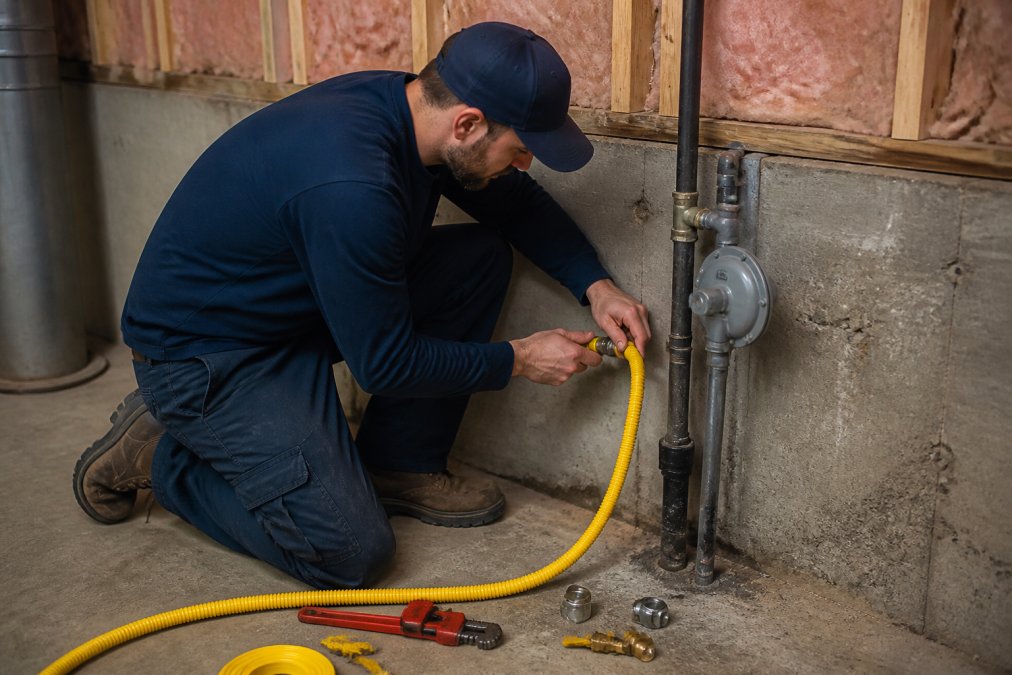
A licensed plumber in work attire installing a flexible yellow CSST gas line in a residential basement, with a pipe wrench and fittings visible on the floor beside him The length of the run is the most obvious factor, as longer distances require more pipe, fittings, and labor hours. The route complexity matters just as much; a straight path through an open basement is far cheaper than a route requiring cutting into finished drywall or drilling through floor joists. Site conditions such as rocky soil or a concrete slab that needs jackhammering can add significant time and cost.
Appliance-Specific Installations
The type of appliance you are connecting influences the cost because different appliances require different pipe diameters and BTU capacities. A gas dryer or cooktop near the meter is a relatively simple hookup, while a tankless water heater or a whole-house generator demands a larger supply line and possibly a dedicated gas manifold to handle the higher demand. Connecting a high-BTU appliance often means upgrading the existing piping, which adds both material and labor to the project.
Retrofitting vs. New Construction
Adding a gas line to an existing home is almost always more expensive than installing one during new construction. In new construction, the plumber has open walls and can run the pipe before the drywall goes up. Retrofitting requires cutting access holes, patching drywall, and working around existing electrical and plumbing lines. This additional complexity is a major reason why retrofits carry a premium over new builds.
DIY Gas Line Installation Safety Risks
DIY gas line installation safety risks are severe, and this is one task where the do-it-yourself approach can have life-threatening consequences. A gas leak from an improperly sealed joint or an incorrectly sized pipe can lead to fire, explosion, or carbon monoxide poisoning. Unlike a leaky faucet, a gas leak is not always detectable by sight or smell.
Beyond the immediate danger, there are legal implications. Most building codes require that gas piping work be performed by a licensed professional, and an unpermitted DIY installation can invalidate your homeowner’s insurance policy. If an incident occurs and the insurance company discovers the work was done without a permit by an unlicensed individual, they may deny the claim entirely.
Hiring a Licensed Gas Plumber: What It Costs
When you hire a licensed gas plumber, you are paying for more than just the physical labor of connecting pipes. The cost covers expertise in calculating correct pipe sizes, knowledge of local building codes, proper tools for pressure testing, and liability insurance. Qualified professionals also carry the necessary permits and schedule required safety inspections.
Hiring a licensed gas plumber is the only way to guarantee your installation meets safety standards and passes inspection. A reputable contractor will provide a detailed written estimate that breaks down material costs, labor, and permit fees before any work begins. To get an accurate quote for your specific project, contact PUR Plumbing for a consultation. Our fully loaded vehicles allow our licensed technicians to handle gas line services efficiently, and our residentially and commercially licensed team has served Pasco County for over 25 years. Contact us today to discuss your installation needs and receive a transparent, itemized estimate.
Frequently Asked Questions
Can a homeowner install their own gas line?
In most areas, no. Gas line work is heavily regulated and typically requires a licensed professional. Attempting a DIY gas line installation is not only dangerous but often illegal. Building codes in the US generally require a permit and inspection for any new gas piping. Trying to bypass these rules puts your home at risk for gas leaks and voids your homeowner’s insurance. Always check with your local authority and hire a licensed gas plumber to ensure the work meets code.
How deep does a residential gas line need to be?
For an underground residential gas line, the standard trench depth is 12 to 18 inches. However, local building codes may specify a different depth based on frost line and soil conditions. A licensed plumber will know the exact code for your area and will also ensure proper trenching and backfilling to protect the pipe. This is a critical factor in your installation cost, as deeper trenches and harder soil conditions increase labor time and project complexity.
Do I need a permit for gas line installation?
Yes, a permit is almost always required. Gas line installation permit requirements exist to ensure safety and compliance with local building codes. The permit process usually involves an application, a fee, and a mandatory inspection of the work. The cost of the permit is a small fraction of the total project but is non-negotiable. Skipping the permit can lead to fines, failed home inspections, and dangerous conditions that your insurance will not cover.
What factors increase the cost of gas line installation?
Several factors drive up the price. The length of the run is primary; longer distances mean more pipe and labor. Trenching for an outdoor line is expensive, especially if there are obstacles like concrete or roots. The material choice matters, with black iron pipe costing less than flexible CSST but requiring more labor. Adding new appliance hookups or a gas manifold also increases the final cost. Finally, local permit fees and the plumber’s labor rates vary by region.
CALL 727-475-1474 and 813-579-1920


CFC 1427929
Serving Pasco County 25+ Years
info@purplumbing.com
Residential Gas Line Installation Cost Guide (2026)
September 16, 2026 | Blog
- Reageer
For more information or to request an appointment dial 727-475-1474 and 813-579-1920
Serving Pasco County 25+ Years, info@purplumbing.com
Carrollwood
Clearwater
Dunedin
Holiday
Land O Lakes
Lutz
New Port Richey
Oldsmar
Palm Harbor
Plant City
Saint Petersburg
Tampa
Tarpon Springs
Temple Terrace
Town N Country
Trinity
West Chase
Site Designed by GoProLocal