Table of Contents
- What Constitutes a Plumbing Emergency
- How to Shut Off the Main Water Valve Before the Plumber Arrives
- How to Find an Emergency Plumber After Hours
- How to Verify a Plumber Is Licensed and Insured
- What Affects the Average Cost of an Emergency Plumbing Call
- What to Do While Waiting for an Emergency Plumber
- Frequently Asked Questions
Last Updated: September 17, 2026
What Constitutes a Plumbing Emergency
A plumbing emergency is any plumbing failure that risks property damage, health, or safety if left until morning. Knowing the difference saves money.
- Burst pipe spraying or leaking water
- Sewer backup pushing waste into your home
- Overflowing toilet that will not stop running
- Water heater failure leaking from the tank
- No water at all across the whole property
- Gas smell near a gas line or appliance
Situations That Need Immediate Attention
Water damage grows fast. A supply line that lets go can soak drywall, warp floors, and feed mold within hours. The EPA guide to indoor mold and moisture notes that mold can begin to grow on wet surfaces within 24 to 48 hours.
Call an emergency plumber right away when you see:
- Water you cannot stop or slow
- Sewage backing into tubs or floor drains
- A water heater leaking from the tank itself
- No water pressure anywhere in the building
Problems You Can Wait Until Morning For
Some issues feel urgent but are not. A dripping faucet, slow drain, or running toilet wastes water but will not flood your home.
You can safely wait on:
- A single clogged sink or shower drain
- A faucet that drips when closed
- A toilet that runs but does not overflow
- Low water pressure with no visible leak
How to Shut Off the Main Water Valve Before the Plumber Arrives
The main water shut-off valve is the single most important thing to find before an emergency. If you do not know where yours is, find it today, not at 2 a.m.

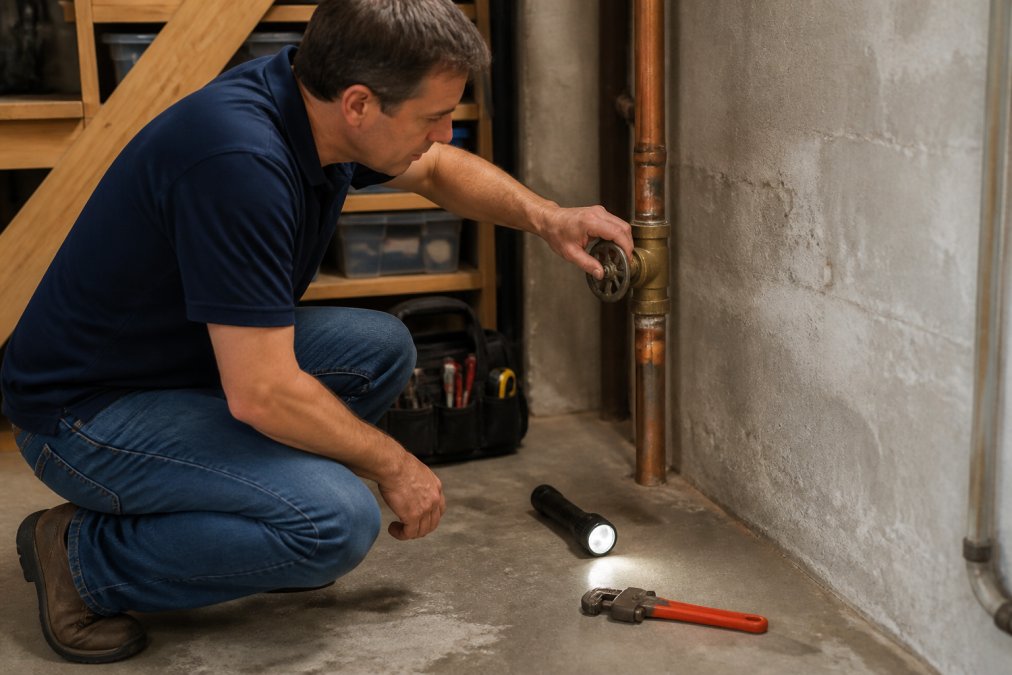
Homeowner using a flashlight to locate the main water shut-off valve before an emergency plumber arrives Here is how to shut it off:
- Locate the valve. It is often near the water meter, in a basement, or in a utility closet.
- Turn the handle clockwise until it stops. Gate valves turn many times. Ball valves turn a quarter turn.
- Open a low faucet, like a tub, to drain the remaining water.
- Leave the valve closed until the plumber says to reopen it.
Temporary Steps to Limit Water Damage
Once the water is off, limit the damage. Do not wait for the plumber to start.
Do these steps now:
- Move furniture, rugs, and electronics off wet floors
- Towel-dry and mop up standing water
- Put buckets under active drips
- Prop open doors and run fans to dry the space
- Take photos of all damage before you clean up
That last step protects your insurance claim.
How to Find an Emergency Plumber After Hours
Finding a reliable emergency plumber after hours comes down to three moves: search, call, and confirm. Search locally for “emergency plumber near me” or “24/7 plumber,” and look for a company that answers live.
- Search for local providers with 24/7 availability.
- Call and see how fast a real person picks up.
- Ask if they can give same-day service.
- Confirm they are licensed and insured before you agree to anything.
Where to Look Beyond a Search Engine
Search results are dominated by paid ads and lead-generation services that sell your call to the highest bidder, adding a markup and slowing response. Better sources:
- Your water utility’s referral list. Many municipal water departments publish licensed plumbers who handle after-hours emergency calls.
- Your homeowner’s insurance app or hotline. Many carriers maintain a vetted contractor network and can dispatch a plumber directly.
- A trusted local plumber’s after-hours line. Even if your regular plumber does not run 24/7, their voicemail often names a partner company that does.
- Neighborhood apps and local Facebook groups. Search the group for “plumber” before posting, real neighbors name real companies.
- The manufacturer’s locator for your water heater or softener. Brands like Rheem, A. O. Smith, and Bradford White list factory-authorized service providers who carry parts for their units.
How to Vet a Company on the Phone in Under Five Minutes
You are checking whether this company can finish the job tonight. Ask these questions in order:
- “Are you dispatching a licensed plumber, or a technician?” In many states, only a licensed plumber can legally perform certain repairs; a technician may only diagnose and shut off.
- “What is your license number?” Write it down and verify it (see the licensing section below).
- “Do you carry the parts for my issue on the truck?” A company that must source a water heater or main valve from a supply house will not finish tonight.
- “What is your total trip charge, and is it credited toward the repair?” Some companies apply the trip fee to the final bill; others do not.
- “How long until the plumber is at my door?” Get a number, not “soon.” If they cannot give one, call the next company.
Red Flags That Mean Hang Up and Call Someone Else
- The dispatcher cannot or will not give a license number.
- They demand payment or a deposit by gift card, wire transfer, or cryptocurrency before anyone arrives. No legitimate plumber operates this way.
- They quote a price over the phone without seeing the problem, then refuse to put it in writing.
- They pressure you to authorize work before you have a written estimate.
- The company name on the phone does not match the name on the truck or the invoice.
A Note on Lead-Generation Sites
Sites that promise to “connect you with a local pro in 30 seconds” usually sell your contact information to multiple contractors. You may get three calls in five minutes, and none may be the company that shows up. If you use one, ask the dispatcher directly: “Are you the company sending the plumber, or a referral service?” If it is a referral service, get the actual plumbing company’s name first.
What to Have Ready When You Call
The call goes faster when you have details ready.
Have these ready:
- Your address and cross street
- What is leaking or backed up
- Whether the water is shut off
- The type of plumbing, like a tank or tankless water heater
- Your best callback number
Clear details help the dispatcher send the right technician with the right parts.
How to Verify a Plumber Is Licensed and Insured
A licensed plumber has met state training and testing requirements. An insured and bonded plumber carries coverage that protects you if something goes wrong. Check both before work begins.
Ask for:
- Their license number, then look it up with your state licensing board
- A certificate of insurance for liability and workers’ comp
- A written service estimate before work starts
What Affects the Average Cost of an Emergency Plumbing Call
The average cost of an emergency plumbing call depends on the time, the job, and the parts. After-hours work usually costs more because of the emergency surcharge.
Most bills include:
- A service call fee to get a technician to your door
- An emergency surcharge for nights, weekends, and holidays
- Labor time based on how long the repair takes
- Parts, like valves, fittings, or a new water heater
Cost Factor What Drives It Up What Keeps It Down Time of call Nights, weekends, holidays Weekday business hours Job type Sewer backup, burst pipe Clogged drain, leaky faucet Parts needed Water heater, main valve Small fittings Access Hidden pipes, tight spaces Easy-to-reach fixtures Questions to Ask About Pricing Before You Agree
Never let a plumber start work without a clear price. Ask:
- What is the service call fee?
- Is there an emergency surcharge, and how much?
- Can you give me a written estimate before you start?
- Is the estimate a flat rate or an hourly rate?
- What happens if the job takes longer than expected?
Watch Out
A common mistake is agreeing to work before you have a written estimate. If the final bill comes in far higher than the quote, you have little room to push back. Get the number in writing first.What to Do While Waiting for an Emergency Plumber
While you wait, focus on safety and damage control. This is also your window to document damage for an insurance claim.
Electrical Safety Comes First
Water and electricity are the most dangerous combination in a plumbing emergency. Before you do anything else:
- Do not walk through standing water if any electrical device is nearby. Water conducts electricity, and a submerged outlet or cord can energize the entire puddle.
- If water is anywhere near outlets, a breaker panel, or a plugged-in appliance, do not touch the water. Go to the breaker panel only if you can reach it without stepping in water, and shut off the breaker for the affected area. If you cannot reach the panel safely, leave the building and call 911.
- Never unplug or plug in anything while standing on a wet floor. Even a small amount of water around a cord is a shock hazard.
- If you smell burning or see sparks, treat it as an electrical fire. Leave immediately and call 911 from outside.
- If the leak is near a gas line or you smell gas, do not flip any switches, use a phone indoors, or strike a match. Leave the building and call your gas utility from outside. The CDC guidance on carbon monoxide and gas safety advises leaving the area and calling for help if you suspect a gas leak.
Document the Damage Before You Clean Up
Your insurance adjuster will want evidence of what happened and what was damaged. Act fast:
- Photograph everything before you move it. Wide shots of the room, then close-ups of the leak source, the water line on walls or furniture, and damaged belongings.
- Take a short video walkthrough. Narrate what you see and the time. Video captures context photos miss.
- Do not throw anything away. Damaged rugs, boxes, and furniture are evidence. Move them to a dry area, but keep them until the adjuster says otherwise.
- Write down the timeline. When you noticed the leak, shut off the water, called the plumber, and when the plumber arrived. Adjusters use this to reconstruct the event.
- Save every receipt. The plumber’s invoice, any hotel stay, and emergency supplies are potentially reimbursable.
- Keep the plumber’s report. Ask the plumber to note the cause in writing. “Supply line failed at the compression fitting” is far more useful to an adjuster than “fixed leak.”
Damage Control While You Wait
Once the water is off and the area is safe:
- Move furniture, rugs, and electronics off wet floors
- Towel-dry and mop up standing water
- Put buckets under active drips
- Prop open doors and run fans to dry the space
- Keep children and pets away from standing water
- Keep the water shut off until the technician arrives
Pro Tip
Snap photos of the leak and the damaged area before the plumber arrives. Insurers often ask for documentation, and having it ready speeds up the claim. If you have a home inventory app or a recent video walkthrough of your home, pull it up now, it makes listing damaged items much faster.Watch Out
Do not use a wet/dry shop vacuum on standing water if there is any chance an electrical cord or outlet is submerged nearby. Unplug the vacuum and move it to a dry area before you start, and never operate it while standing in water.Frequently Asked Questions
How much does an after-hours emergency plumber cost?
Most companies charge a service call fee plus an emergency surcharge for nights, weekends, and holidays. The final bill depends on the problem, parts, and how long the job takes. Ask for a service estimate before work begins so there are no surprises. Pricing varies by provider, so confirm rates directly when you call.
Can you call a plumber in the middle of the night?
Yes. Many plumbing companies offer 24/7 availability with an on-call technician who can be dispatched overnight. When you call, describe the problem clearly, confirm the emergency surcharge, and ask when someone can arrive. A burst pipe, sewer backup, or water heater failure at 2 a.m. is exactly the kind of situation after-hours service exists for.
How can I verify an emergency plumber is licensed and insured?
Ask for the license number and confirm it with your state or local licensing board. Request a certificate of insurance showing general liability and workers’ compensation coverage. A legitimate plumbing contractor will share these without hesitation. Being insured and bonded protects you if something goes wrong during the repair.
What should I do while waiting for an emergency plumber to arrive?
Shut off the main water shut-off valve to stop the flow, then open a low faucet to drain remaining water from the lines. Move furniture and electronics away from the leak, and place towels or buckets to catch drips. If water is near electrical outlets or your panel, stay clear and call an electrician. Take photos of the damage for your insurance claim.
CALL 727-475-1474 and 813-579-1920


CFC 1427929
Serving Pasco County 25+ Years
info@purplumbing.com
How to Find an Emergency Plumber After Hours
September 18, 2026 | Blog
- Reageer
For more information or to request an appointment dial 727-475-1474 and 813-579-1920
Serving Pasco County 25+ Years, info@purplumbing.com
Carrollwood
Clearwater
Dunedin
Holiday
Land O Lakes
Lutz
New Port Richey
Oldsmar
Palm Harbor
Plant City
Saint Petersburg
Tampa
Tarpon Springs
Temple Terrace
Town N Country
Trinity
West Chase
Site Designed by GoProLocal