Table of Contents
- Why the 40-Gallon Rule Fails Your Family of 4
- First Hour Rating Explained: The Number That Actually Matters
- Peak Hour Demand Calculation for a Family of 4
- Tank vs Tankless Water Heater for Family of 4
- Gas vs Electric Sizing: BTU Input and Voltage Requirements
- Retrofitting Challenges and Installation Footprint
- Signs Your Current Water Heater Is Too Small
- Conclusion: Matching Water Heater Size to Your Household
- Frequently Asked Questions
Last Updated: October 2, 2026
Why the 40-Gallon Rule Fails Your Family of 4
Most sizing charts say a family of four needs a 40-gallon tank. That advice fails daily: a 40-gallon tank holds 40 gallons but reheats slowly, so once it empties, you wait.
Learning how to choose a water heater size for family of 4 starts with one shift: stop counting people and start counting hot water used in your busiest hour. At PUR Plumbing, we have installed and replaced water heaters across Pasco County for more than 25 years, and homes that run cold almost always share the same problem, the tank was sized by headcount, not demand.
Three things actually decide the right size:
- How much hot water your family uses at peak times
- The first-hour rating of the unit, not its tank size
- Your incoming water temperature, which matters more in cooler months
You can work all of this out in about 15 minutes.
First Hour Rating Explained: The Number That Actually Matters
The first-hour rating (FHR) is the amount of hot water a heater can supply in one hour of heavy use, starting with a full tank.
A 40-gallon tank with a strong burner can beat a 50-gallon tank with a weak one. That is why headcount charts conflict so often. The U.S. Department of Energy water heating guidance recommends comparing the FHR directly against your peak-hour demand before you buy.

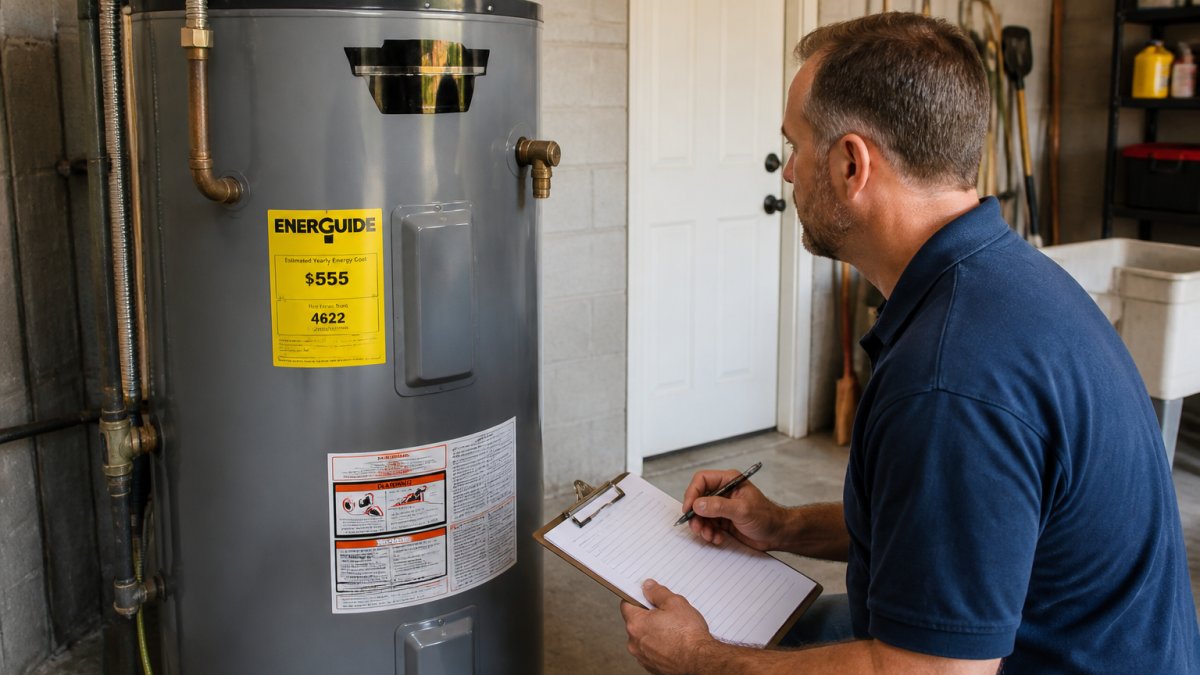
A homeowner reading the yellow EnergyGuide label on a residential water heater in a clean garage utility area, with a clipboard and pen nearby for notes Key Takeaway
Match the FHR to your busiest hour, not to your family size. A unit with an FHR at or just above your peak demand will keep up. One below it will run cold.How to Read the FHR Label on Any Water Heater
Every new water heater carries a yellow EnergyGuide label. Find the first-hour rating in gallons, then check the energy factor or uniform energy factor nearby. A higher FHR means more hot water per hour; a higher efficiency rating means lower utility costs over the unit’s life.
Peak Hour Demand Calculation for a Family of 4
Peak hour demand is the total hot water your household uses during its busiest 60 minutes. Add up every hot-water task in that hour:
- Shower: 10 gallons for 5 minutes at 2.0 showerhead GPM
- Bath: 20 gallons
- Shaving or hand washing: 2 gallons
- Dishwasher: 6 gallons
- Clothes washer: 7 gallons
- Food prep and cleanup: 4 gallons
Now build your worst-case hour. A realistic morning for four might look like this:
Task Gallons Used Two showers back to back 20 One bath for a younger child 20 Shaving and hand washing 4 Breakfast cleanup 4 Peak hour demand 48 That 48 gallons is your target, so look for an FHR of at least 48 to 50. A basic 40-gallon tank often carries an FHR near 50, which is why the old rule sometimes works by accident. Add a third shower or a load of laundry, and it fails.
Accounting for Simultaneous Usage Patterns
Most charts assume one fixture runs at a time, but real families do not live that way. If two showers, a dishwasher, and a washing machine run together, demand can jump past 60 gallons in an hour. Size for the overlap, not the average.
Tank vs Tankless Water Heater for Family of 4
The tank vs tankless water heater for family of 4 choice comes down to flow rate and temperature rise, not tank size. A tankless on-demand unit has no storage tank; it heats water as it passes through, so it never runs out but can only heat so many gallons per minute.
Tankless sizing uses flow rate, measured in gallons per minute (GPM). Add up the fixtures you expect to run at once:
- Standard showerhead: about 2.0 GPM
- Kitchen faucet: about 1.5 GPM
- Dishwasher: about 1.5 GPM
Two showers plus a faucet needs roughly 5.5 GPM of hot water at once. Choose a tankless unit rated above that number at your incoming water temperature.
Factor Tank Tankless Sized by First-hour rating Flow rate (GPM) Runs out of hot water Yes, at peak No Standby heat loss Yes, ongoing None Installation footprint Large Small Venting Standard Often upgraded Flow Rate and Groundwater Temperature in Warm Climates
Groundwater temperature changes how much work a heater does. In warm climates, incoming water starts warmer, so a tankless unit needs less energy to reach your set point. In cooler months, incoming water drops and the same unit produces fewer GPM. Always size tankless capacity for the coldest month.
Gas vs Electric Sizing: BTU Input and Voltage Requirements
Gas and electric heaters are sized the same way, by FHR and peak demand. The difference is how they recover, and recovery determines whether your FHR holds up during a busy hour. Gas units list BTU input, and higher BTUs mean faster recovery. Electric units list wattage and voltage requirements, and recovery depends on the electric resistance elements. A gas unit usually recovers faster at the same tank size, so it can carry a higher FHR for the same gallon capacity. Electric installs are simpler where no gas line exists, but recovery is slower. Check the ENERGY STAR water heater specifications for efficiency ratings before you compare models.
Recovery Math: Why BTU Input and Wattage Decide Your FHR
Recovery rate is the gallons a heater can bring back to set temperature in one hour, driven by heat input and temperature rise:
Recovery (GPH) = (Input × Efficiency) ÷ (8.33 × Temperature Rise)
Input is in BTUs per hour, 8.33 is the weight of a gallon of water in pounds, and temperature rise is your set point minus incoming groundwater temperature.
Run the numbers for the two most common residential gas inputs:
Input Efficiency Rise Recovery (GPH) 40,000 BTU/hr 0.80 70°F ~55 40,000 BTU/hr 0.80 60°F ~64 50,000 BTU/hr 0.80 70°F ~69 50,000 BTU/hr 0.80 60°F ~80 Now the same math for electric. A 4,500-watt element equals about 15,350 BTU/hr; a 5,500-watt element equals about 18,760 BTU/hr.
Element BTU/hr Equivalent Rise Recovery (GPH) 4,500 W ~15,350 70°F ~26 4,500 W ~15,350 60°F ~31 5,500 W ~18,760 70°F ~32 5,500 W ~18,760 60°F ~38 This is the mechanism behind the old rule of thumb. A 40-gallon gas tank with a 40,000 BTU burner recovers roughly 55 GPH, so its FHR lands near 50 to 55 gallons.
Voltage and Circuit Requirements for Electric Units
Electric water heaters run on dedicated 240-volt circuits, and amperage draw scales with wattage:
- 3,500 to 4,500 watts: typically a 30-amp, 240-volt circuit with 10-gauge wire
- 5,500 watts: typically a 30-amp, 240-volt circuit with 10-gauge wire, but verify the nameplate
- Larger or dual-element units: may require a 40-amp circuit with 8-gauge wire
If your existing circuit is 30 amps and the new unit needs 40, the upgrade can mean pulling new wire through finished walls, which is why some homeowners stay with gas even when electric looks cheaper on the shelf.
Gas Line and Venting Constraints
Gas units have their own constraints. A higher BTU input unit may need a larger gas line: a 40,000 BTU unit often works on a half-inch line at a short run, but a 50,000 BTU unit at a longer run may need three-quarter-inch pipe. Venting matters too. Standard atmospheric units need a vertical flue or a properly sized horizontal run to an exterior wall; high-efficiency condensing units use PVC venting but produce condensate that must be drained; power-vented units can run through a side wall but need an electrical outlet nearby.
Watch Out
Sizing a heater by tank gallons alone hides recovery speed. Two 50-gallon units can have very different first-hour ratings, and the weaker one will run cold during your busiest hour. Always compare the FHR on the EnergyGuide label, not the tank size on the box.Which One Fits Your Home
Use this decision path:
- If a gas line already serves the water heater location and venting is adequate, a gas unit usually delivers a higher FHR per dollar and recovers faster.
- If no gas line exists and running one is impractical, an electric unit is the practical choice, but size up the tank or choose a higher-wattage element to compensate for slower recovery.
- If your peak demand is above 60 gallons per hour and you want to stay with a tank, a 50-gallon gas unit with a 50,000 BTU burner is often the smallest unit that keeps up.
- If your panel cannot support a larger electric circuit, that constraint may push you toward gas or toward a tankless unit with its own dedicated circuit.
A licensed plumber can confirm gas line size, venting path, and circuit capacity in a single site visit.
Retrofitting Challenges and Installation Footprint
Replacing a heater is not always a straight swap. The installation footprint and existing connections often decide what fits. A 50-gallon tank that will not fit your utility closet is not a solution, no matter what the FHR says.
The 40-to-50 Gallon Upgrade: What Actually Changes
The most common upgrade for a family of four is moving from a 40-gallon tank to a 50-gallon tank:
Dimension Typical 40-Gallon Typical 50-Gallon Height 48 to 58 inches 48 to 62 inches Diameter 18 to 20 inches 20 to 22 inches Full weight 400 to 450 lbs 480 to 540 lbs Clearance needed 6 to 12 inches around 6 to 12 inches around Utility closets, garage platforms, and basement alcoves were often framed to the exact size of the original unit. A 50-gallon tank is typically 2 to 4 inches wider and up to 4 inches taller than the 40-gallon it replaces, in a tight closet, that difference is the whole job.
The Five Retrofit Constraints That Decide the Job
1. Physical space and platform capacity. A full 50-gallon tank weighs roughly 500 pounds.
2. Venting path. A standard atmospheric gas unit needs a flue that rises vertically or runs horizontally to an exterior wall with proper pitch.
**3.
4. Electrical circuit. If the new unit draws more amperage than the old circuit can supply, the circuit, breaker, and wire may all need upgrading.
5. Code-driven additions. A thermal expansion tank is often required on a closed system, and a mixing valve may be needed to keep delivery temperature safe when the tank runs hotter than the fixtures need. Local plumbing code governs these details.
When the Tank Will Not Fit: Three Practical Alternatives
If the space cannot take a larger tank, three paths work in real homes:
- Go tankless. A tankless unit mounts on a wall and frees the floor space entirely. The trade-off is that it needs its own venting and, for electric models, a dedicated circuit that may be larger than the old tank circuit.
- Stay at 40 gallons but raise the FHR. A 40-gallon gas unit with a 50,000 BTU burner can carry an FHR close to what a weaker 50-gallon unit delivers.
- Add a second small tank or a recirculation setup. A pair of smaller tanks or a recirculation loop solves the peak-demand problem without forcing a single oversized unit into a space that cannot hold it.
Measure Before You Buy
Before you order anything, measure the existing unit and the space around it:
- Height from floor to the nearest obstruction above the unit
- Width and depth of the alcove or closet opening
- Distance from the unit to the nearest gas line, electrical outlet, and vent termination
- Whether the platform or floor can carry the full weight of a filled tank
A five-minute measurement prevents the most common and most expensive retrofit mistake: buying a tank that fits the demand but not the closet.
Pro Tip
If you are upgrading from a 40-gallon to a 50-gallon tank, photograph the existing connections, venting, and clearances before the old unit is removed. Those photos make it far easier to match the new unit to what is already there.Signs Your Current Water Heater Is Too Small
Your heater may already be telling you it is undersized:
- Hot water runs out during morning showers
- The tank recovers slowly between uses
- Water is warm, not hot, when two fixtures run at once
- The unit runs constantly during peak hours
- You have added family members or appliances since installation
A water heater lifespan of 10 to 15 years also matters. An aging unit loses efficiency, and replacement often beats repair. If your heater is near the end of its life and undersized, replacing it solves both problems.
Pro Tip
Before you replace anything, run the shower test. Time how long a shower stays hot with the dishwasher running. If it goes cold in under five minutes, your peak demand is beating your FHR.Conclusion: Matching Water Heater Size to Your Household
Sizing a water heater is a math problem, not a guessing game. Add up your peak hour demand, then match it to a first-hour rating at or above that number. Check flow rate for tankless, and account for groundwater temperature and retrofit limits.
At PUR Plumbing, we handle water heater installation and tankless options for homes and businesses across Pasco County. Our licensed team is family owned and operated, with fully loaded vehicles for fast repairs, and we have served the area for more than 25 years.
Get started with PUR Plumbing and get the right-sized water heater the first time. Contact Us today.
Frequently Asked Questions
What size electric water heater do I need for a family of 4?
For most families of 4, a 50-gallon tank with a first hour rating of 60 to 75 gallons works well. If you have teenagers or everyone showers in the morning, aim for the higher end. Electric models recover slower than gas, so size up if your household uses hot water in tight windows. Check the FHR label, not just tank capacity.
How does peak hour demand affect water heater sizing?
Peak hour demand is the total hot water your family uses during your busiest 60 minutes. Add up simultaneous activities: two showers at 2.5 GPM for 10 minutes each equals 50 gallons, plus a dishwasher cycle at 6 gallons and laundry at 7 gallons. That totals 63 gallons. Your water heater’s first hour rating must meet or exceed this number.
Is a 40-gallon hot water tank big enough for a family of four?
A 40-gallon tank can work for a family of 4 with short showers and staggered schedules, but it often runs out during back-to-back morning routines. Most 40-gallon models have a first hour rating around 50 to 55 gallons. If your peak hour demand exceeds that, you will run cold. A 50-gallon tank gives more buffer.
What is the difference between tank and tankless water heater sizing?
Tank sizing uses first hour rating and recovery rate. Tankless sizing uses flow rate in gallons per minute and temperature rise. For a family of 4, a tankless unit needs to handle 6 to 8 GPM if two showers run at once. In warmer climates, lower temperature rise means a smaller tankless unit can work. Tankless never runs out, but it limits simultaneous flow.
CALL 727-475-1474 and 813-579-1920


CFC 1427929
Serving Pasco County 25+ Years
info@purplumbing.com
How to Choose a Water Heater Size for a Family of 4
October 3, 2026 | Blog
- Reageer
For more information or to request an appointment dial 727-475-1474 and 813-579-1920
Serving Pasco County 25+ Years, info@purplumbing.com
Carrollwood
Clearwater
Dunedin
Holiday
Land O Lakes
Lutz
New Port Richey
Oldsmar
Palm Harbor
Plant City
Saint Petersburg
Tampa
Tarpon Springs
Temple Terrace
Town N Country
Trinity
West Chase
Site Designed by GoProLocal