Table of Contents
- What Homeowners Insurance Covers for Plumbing Issues
- Is a Pipe Burst Covered by Insurance?
- Plumbing Problems Insurance Won’t Cover
- How to File a Plumbing Insurance Claim
- When to Call an Emergency Water Heater Repair Service
- What to Do When Your Plumbing Claim Is Denied
- Home Insurance vs. Home Warranty: What’s the Difference?
- Frequently Asked Questions
Last Updated: September 23, 2026
What Homeowners Insurance Covers for Plumbing Issues
Emergency plumbing issues covered by insurance typically hinge on one word: sudden. According to the Insurance Information Institute’s guide to homeowners insurance, standard policies generally pay for water damage that happens without warning, while problems that build slowly over months usually fall outside coverage.
Sudden and Accidental Damage vs. Wear and Tear
Sudden and accidental damage means a failure you could not have reasonably predicted: a supply hose that lets go, a pipe that cracks during a freeze, a toilet that overflows while you are at work. Insurance generally covers the resulting water damage.
Dwelling Coverage vs. Personal Property Coverage
Dwelling coverage pays to repair the structure itself: drywall, flooring, cabinetry, and built-in plumbing components.
Watch Out
Photograph your belongings room by room before any loss happens. Without a pre-loss inventory, adjusters have no baseline to compare against, and you may end up arguing over what you owned rather than what it cost to replace.Is a Pipe Burst Covered by Insurance?
A burst pipe is usually covered when the failure is sudden and the damage accidental. The Insurance Information Institute notes freezing is one of the most common causes of burst pipe claims, so policies often pay for the resulting water damage even when they question how the pipe failed.
When Pipe Corrosion Changes the Outcome
Pipe corrosion turns a covered event into a denied one. Once an adjuster determines a pipe failed because it had been rusting for years, the claim shifts from “sudden and accidental” to “wear and tear,” which most policies exclude.
Plumbing Problems Insurance Won’t Cover
Standard policies exclude a predictable list of plumbing failures. Knowing it in advance saves homeowners from filing claims that will only be denied.
Common Exclusions: Seepage, Negligence, and Lack of Maintenance
- Seepage: Water that leaks slowly over time and stains, warps, or rots materials
- Negligence: Damage you caused by ignoring an obvious problem, such as a running toilet or a dripping supply line
- Lack of maintenance: Failures tied to deferred service, including corroded pipes and clogged drains left untreated
- Water backup: Sewer or drain backup, unless you purchased a specific endorsement
- Mold remediation: Often capped or excluded unless the mold traces directly to a covered peril
Problem Typically Covered? Why Burst supply pipe Yes Sudden and accidental Frozen pipe damage Usually Sudden failure from freezing Slow leak under sink No Seepage over time Corroded galvanized pipe No Wear and tear Sewer line backup Only with endorsement Excluded by default Toilet overflow (sudden) Yes Accidental discharge Toilet running for weeks No Negligence Key Takeaway
The single most useful thing you can do is document the condition of your plumbing before anything fails. Age, material, and last service date turn a disputed claim into a straightforward one.How to File a Plumbing Insurance Claim
Filing a plumbing insurance claim follows a predictable sequence: homeowners who get paid fastest document first and repair second. Most carriers expect notice within a defined window after discovery, so speed matters, but evidence wins claims. The gap between a fast denial and a fast payout usually comes down to whether the file proves the loss was sudden.

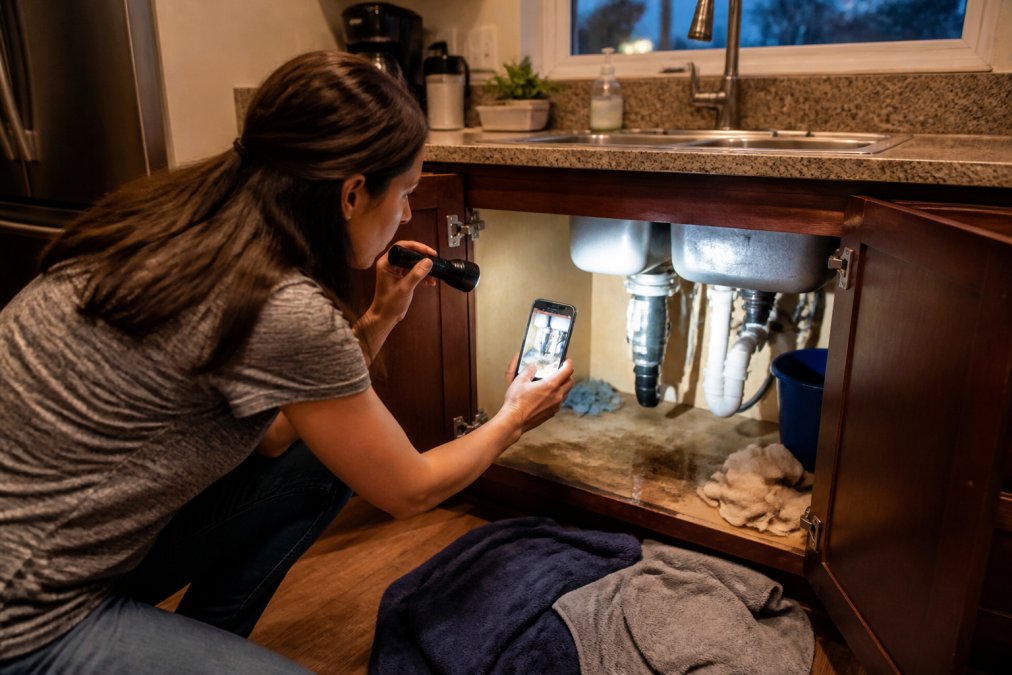
Homeowner documenting water damage under a sink to handle emergency plumbing issues covered by insurance. Step-by-Step Documentation Guide
- Stop the water. Shut off the main supply valve first and note the exact time.
- Photograph everything before you clean. Wide shots of the room, mid-range shots of the affected cabinet or wall, and close-ups of the failed pipe or fitting, include a coin or ruler in one close-up so scale is unambiguous.
- Record video. A slow narrated walkthrough creates a timestamped record that is hard to dispute. Say the date, the room, and what you are seeing out loud.
- Write down the timeline. When you noticed it, shut the water off, called the plumber, and called the carrier. Adjusters compare your timeline against weather records and your service history.
- Keep every receipt. Emergency repairs, hotel stays, rental extraction equipment, and replacement essentials all count. Keep originals and submit copies.
- Get a written assessment. A licensed plumber’s report carries weight with adjusters, but only if it states the cause of failure, whether it was sudden or gradual, the material and approximate age of the failed component, and whether prior deterioration was visible.
- Submit the claim in writing. Follow up by phone and note the claim number, the adjuster’s name, and the date of every conversation.
What Adjusters Actually Look For
A claim file is an argument about causation. The adjuster answers one question: did this fail suddenly, or was it already failing? Everything you submit should answer that directly.
Watch Out
Do not throw away the failed pipe or fitting. Adjusters and, in disputed claims, appraisers may want to inspect the actual component. Bag it, label it with the date and location, and keep it until the claim is closed.Your Duty to Mitigate Further Damage
Your duty to mitigate is a policy condition, not a suggestion: take reasonable steps to prevent additional damage, such as shutting off the water, extracting standing water, and running fans or dehumidifiers.
Pro Tip
Keep a shop vacuum, a few box fans, and a stack of old towels in one place. When a pipe lets go at 2 a.m., you will not be searching the garage for them, and those first thirty minutes of extraction are the ones that matter most.When to Call an Emergency Water Heater Repair Service
Call an emergency water heater repair service the moment you see water pooling around the tank base, hear hissing, or lose hot water in cold weather. A failing tank can release its full contents in minutes.
What to Do When Your Plumbing Claim Is Denied
A denied plumbing claim is not always final. Most carriers offer a formal appeal or reconsideration process, and many denials get reversed when the homeowner supplies better documentation. Treat the denial as the start of a paper trail, not the end of the conversation.
Step 1: Get the Denial in Writing With the Policy Language Cited
Call the adjuster and ask for the denial in writing, citing the specific policy section the carrier relies on, usually a wear-and-tear exclusion, a seepage exclusion, or a maintenance clause. Without that language, you are arguing against a conclusion instead of a reason.
Step 2: Build Counter-Evidence on Causation
The denial almost always rests on a claim that the failure was gradual. Your job is to rebut that with specifics:
- A plumber’s report stating the cause was sudden and identifying the failed component
- Photographs showing no prior staining, corrosion, or deterioration around the failure point
- Service records showing the system was maintained
- Weather records if freezing was involved
- Any prior inspection reports that noted the pipe in good condition
Step 3: Use the Appraisal Clause if Your Policy Has One
Many homeowners policies include an appraisal clause. If you and the insurer disagree on the amount of the loss, not whether it is covered, either side can demand appraisal. Each side hires an independent appraiser, and the two pick a neutral umpire if they cannot agree. The result is generally binding on the amount.
Step 4: File a Complaint With Your State Insurance Department
Every state has an insurance department that accepts consumer complaints against carriers. A complaint does not guarantee a reversal, but it creates a formal record and typically triggers a carrier response within a defined window, often the point at which a stalled claim gets a second look.
Step 5: Consider a Public Adjuster, With Eyes Open
A public adjuster works for you, not the carrier, and typically charges a percentage of the settlement. For a large loss with a disputed cause, that can be worth it; for a small claim, the fee may exceed the difference. Get the fee structure in writing before signing.
Key Takeaway
The appeal process rewards persistence and paperwork, not anger. The homeowners who get denials reversed are the ones who request the policy citation, rebut the causation argument with a plumber’s report, and escalate through the appraisal clause or a department complaint when the internal appeal stalls.Home Insurance vs. Home Warranty: What’s the Difference?
Home insurance and a home warranty cover completely different things, and confusing them is one of the most expensive mistakes a homeowner can make.
Feature Home Insurance Home Warranty Covers sudden damage Yes No Covers wear and tear No Yes Covers water damage to home Yes No Covers pipe replacement Rarely Often Typical trigger Accident or peril Breakdown from age Best for Catastrophic loss Aging systems Frequently Asked Questions
What kind of plumbing issues are covered by insurance?
Homeowners insurance typically covers sudden and accidental water damage from burst pipes, supply hose failures, and appliance ruptures. If a pipe bursts inside a wall and soaks your drywall and flooring, that damage is usually covered under dwelling coverage. Personal property coverage handles damaged furniture or electronics. However, the pipe repair itself may or may not be covered depending on your policy and the cause. Damage from gradual wear and tear, corrosion, or neglect is excluded.
Is a pipe burst covered by insurance if the pipe was old?
Age alone doesn’t automatically disqualify a pipe burst claim, but pipe corrosion and deterioration are common exclusions. If your insurer determines the pipe failed because it was corroded or past its useful life, they may deny the claim. Documentation matters here. A licensed plumber’s report stating the pipe failed suddenly rather than from gradual deterioration strengthens your case. Review your policy exclusions before filing.
How do I document a plumbing emergency for an insurance claim?
Start by photographing and videoing all damaged areas before you clean up, including standing water, damaged walls, flooring, and personal property. Keep a written log of the date, time, and cause. Save receipts for emergency repairs, hotel stays, and any temporary fixes. Get a written assessment from a licensed plumber explaining the cause. Do not throw away damaged items until the adjuster has seen them. This documentation supports both your initial claim and any appeal.
What should I avoid saying to an insurance adjuster after water damage?
Avoid speculating about the cause or how long the problem existed. Statements like ‘I noticed a slow leak months ago’ or ‘I should have replaced that pipe sooner’ can be used to deny your claim based on negligence or lack of maintenance. Stick to facts: what happened, when you discovered it, and what you did to stop the damage. Let your plumber’s written report speak to the cause. If unsure, ask the adjuster to clarify their questions before answering.
CALL 727-475-1474 and 813-579-1920


CFC 1427929
Serving Pasco County 25+ Years
info@purplumbing.com
Emergency Plumbing Issues Covered by Insurance
September 24, 2026 | Blog
- Reageer
For more information or to request an appointment dial 727-475-1474 and 813-579-1920
Serving Pasco County 25+ Years, info@purplumbing.com
Carrollwood
Clearwater
Dunedin
Holiday
Land O Lakes
Lutz
New Port Richey
Oldsmar
Palm Harbor
Plant City
Saint Petersburg
Tampa
Tarpon Springs
Temple Terrace
Town N Country
Trinity
West Chase
Site Designed by GoProLocal