Table of Contents
- Can a Plumber Install a Gas Line?
- Gas Line Installation Permit Requirements
- Gas Line Installation for Gas Stove and Appliances
- Gas Line Installation Cost Breakdown
- Gas Line Inspection and Pressure Test Procedures
- Key Differences: Licensed Plumbers vs. Gas Fitters
- What to Expect During Professional Installation
- Frequently Asked Questions
Last Updated: October 9, 2026
Can a Plumber Install a Gas Line?
Yes, a plumber can install a gas line, but not all plumbers are licensed to do so. It depends on your location, the scope of work, and the certifications your plumber holds.
A plumber who installs a gas line must hold proper credentials. Many states and municipalities require a separate gas fitter license beyond standard plumbing credentials; some plumbers hold both, others refer gas work out.
Gas Line Installation Permit Requirements
Permit rules diverge more than anything else on a gas line project. Here’s who pulls the permit, what triggers one, and how inspections run.
Who pulls the permit
In most jurisdictions, the licensed contractor who performs the work pulls the permit, because the permit is tied to the license and the inspection to the permit. A few allow a homeowner to pull an owner-builder permit for their primary residence, but the work usually still requires a licensed trade, and it can forfeit protections if the home is sold within a defined period.
Watch Out
If a contractor offers to do the work “without a permit to save you money,” treat that as a disqualifying red flag. Unpermitted gas work can complicate insurance claims, resale, and any future inspection of the system.What triggers a permit
Common trigger patterns:
- New gas line installation. Permit required essentially everywhere.
- Replacement of an existing gas line. Permit required in most jurisdictions, even when the route is unchanged.
- Relocation of an appliance or a gas outlet. Usually treated as new installation.
How the inspection sequence works
A typical permitted project runs through three checkpoints:
- Rough-in inspection. After the pipe is installed and supported but before walls close or trenches are backfilled. The inspector verifies pipe sizing, support spacing, routing, utility clearance, and protection through framing or masonry.
- Pressure test. The new section is isolated, pressurized, and monitored. Test pressure and hold time are set by code and the inspector. Any pressure drop indicates a leak and fails the test.
- Final inspection and approval. After the pressure test passes and the appliance is connected, the inspector approves the system. Some jurisdictions require the appliance running during the final; others don’t.
Pro Tip
Ask your contractor to schedule the rough-in inspection before any drywall is closed or any trench is backfilled. Reopening finished work to satisfy an inspector is one of the most avoidable costs on a gas line project.What the inspector is looking for
Common inspection checkpoints include:
- Pipe diameter adequate for the appliance load and run length
- Correct pipe material and fittings for the application and jurisdiction
- Shut-off valve accessible at the appliance
Permit fees and how they are set
Permit fees are set locally under one of two structures:
- Flat fee. A fixed charge per permit, sometimes with a small add-on per fixture or appliance.
- Valuation-based fee. Calculated from declared project value or a schedule tied to the work type.
The same nominal job can carry very different permit costs in adjacent jurisdictions, so the contractor should show the permit fee as a separate estimate line.
Documentation to keep after the job
- The approved permit and final inspection sign-off
- The pressure test record, including test pressure and hold time
- The contractor’s license number and the licensed individual who performed the work
Keep these with your home records. They matter at resale, insurance renewal, and when a future contractor ties into the system.
Key Takeaway
Permits are jurisdiction-specific, but the pattern is consistent: a licensed contractor pulls the permit, the rough-in is inspected before walls close, the line is pressure tested, and the final inspection approves the system for use. Confirm the trigger rules with your local building department before work starts.Gas Line Installation for Gas Stove and Appliances
Stove and Range Connections

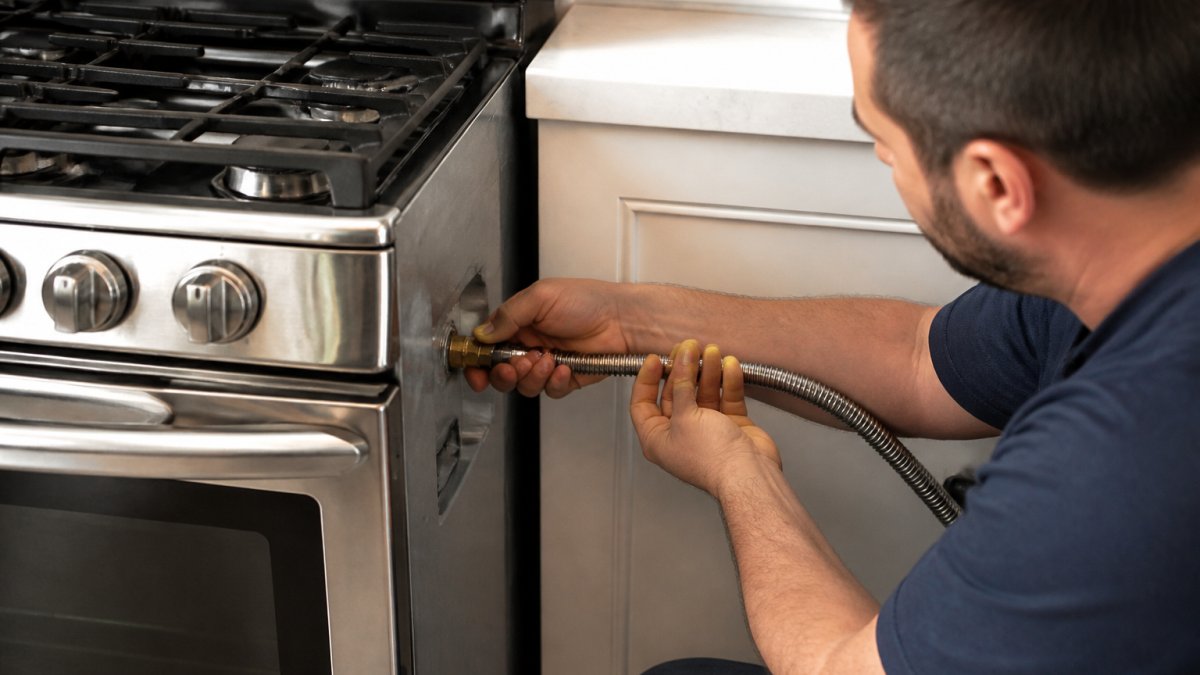
Licensed plumber connecting flexible gas line to stainless steel gas stove in modern kitchen, showing the connection point and flexible tubing clearly What the installation includes:
- Running pipe or tubing from the main gas line to the stove location
- Installing a shut-off valve near the appliance
- Connecting the appliance with flexible tubing or rigid pipe
Most kitchen jobs take a few hours; if the line already runs near the stove, it’s faster, while running across the home or through walls adds time and cost.
Common challenges:
- Finished walls require careful routing
- Concrete slabs may need cutting or trenching
- Older homes may have outdated gas infrastructure needing upgrades
Dryer and Water Heater Hookups
Gas dryers and water heaters require dedicated gas lines and run frequently, so installation must be done correctly.
Gas dryer connections:
- Require a dedicated gas line from the main supply
- Need a shut-off valve within 6 feet of the appliance
- Use flexible tubing rated for gas (not regular plumbing tubing)
Gas water heater hookups:
- Connect to the main gas line with proper pipe sizing
- Require a shut-off valve accessible to the user
- Need venting to the outside (separate from gas line installation but part of the overall job)
Both are straightforward if the gas line runs nearby; a new line from the main supply takes longer and costs more.
Gas Line Installation Cost Breakdown
Lump-sum price ranges are meaningless once a contractor walks the property. The useful approach is to break the job into cost components and show how each scales with conditions at your home.
The four scopes that get confused with each other
Before comparing quotes, identify which scope you’re buying. Mixing these up is the biggest reason homeowners think they were overcharged.
- Appliance connection only. The line already terminates near the appliance: shut-off valve, connector, drip leg where required, leak test, startup. Smallest scope.
- New branch line inside the home. A new run from an existing trunk to a new appliance location. The most common residential project.
- New trunk or main line inside the home. The main distribution line is extended or replaced, often because capacity is insufficient or pipe is undersized or corroded.
- Exterior service lateral. The buried line from the utility’s meter or service stub to the home. Often involves the utility, excavation, and restoration, and is frequently quoted separately.
A quote that says “install gas line: $X” without naming the scope is not comparable to anything.
Itemized cost components
Every project combines some of these line items. Ask for each separately.
- Permit and inspection fees. Paid to the local building department; jurisdiction-specific. Usually passed through at cost.
- Labor. The dominant line item on interior jobs. Scales with run length, fittings, wall and ceiling access, and routing time.
- Pipe and fittings. Black steel, CSST, and copper carry different material and labor profiles. Fittings, valves, and the appliance shut-off valve are separate lines on a good quote.
A per-foot framework you can actually use
Per-foot pricing is the fastest way to sanity-check a quote, but only if you know the condition category. The categories below describe conditions, not prices. Ask your contractor which fits your job and how the per-foot rate changes between them.
- Accessible indoor run. Unfinished basement or open crawl space, straight path, no concrete. Least expensive per-foot condition.
- Finished-wall indoor run. Drywall opened and closed, or routed through attic or soffit. Labor rises sharply due to access and restoration.
- Crawl space with limited clearance. Slow work, sometimes needing a second person, often a shorter maximum run per day.
Pro Tip
When you get three quotes, ask each contractor to state the per-foot rate for the condition category your job falls into, plus a separate line for permits, excavation, and restoration. Quotes that only give a total cannot be compared.Worked examples of how the total is built
These are structural examples, not price quotes, showing which line items appear in each scenario.
Example 1: Kitchen range, existing gas trunk nearby. Appliance connection plus a short branch: permit, labor (a few hours), shut-off valve, connector, drip leg, pressure test, inspection.
Example 4: Replacing an undersized or corroded trunk line. New trunk: permit, labor (often the largest single line), pipe and fittings, possible wall or ceiling access, pressure test, inspection.
Why two quotes for the same job can differ so much
Three mechanisms explain most of the spread:
- Scope mismatch. One quote includes restoration and permits; the other doesn’t.
- Condition mismatch. One contractor priced an accessible run; the other assumed finished-wall access.
- Material mismatch. CSST versus black steel changes material and labor, and code acceptance varies by jurisdiction.
Key Takeaway
A gas line quote is only meaningful when it names the scope, the condition category, the per-foot rate, and every excluded line item. If any of those are missing, ask before you sign.What to ask for on the written estimate
- Scope in plain language (appliance connection, branch line, trunk line, or service lateral)
- Run length in feet and condition category
- Pipe material and fitting type
That structure turns a vague range into a number you can defend.
Gas Line Inspection and Pressure Test Procedures
Every completed gas line installation must pass inspection and pressure testing, the safety checkpoint that confirms your system is safe to use.
The pressure test process:
- Your plumber isolates the new line from the main supply
- A pressure gauge connects to the line
- The system is pressurized (typically 10-15 PSI for residential lines)
What the building inspector checks:
- Proper pipe sizing for the application
- Correct valve placement and accessibility
- Secure connections and fittings
The inspector won’t approve the line until it passes all checks, protecting your home and family.
Key Differences: Licensed Plumbers vs. Gas Fitters
Not all gas line professionals carry the same credentials. The difference matters when hiring.
Licensed plumbers:
- Hold a state or municipal plumbing license
- Train in water supply, drainage, and venting
- May or may not be certified for gas work
Licensed gas fitters:
- Hold a gas fitter or gas technician license
- Train extensively in gas safety, pressure testing, and code compliance
- Specialize in natural gas and propane systems
Why it matters:
Hiring someone without the right license violates code and voids your permit. If something goes wrong, insurance may not cover unpermitted or improperly licensed work.At PUR Plumbing, our team holds the licenses required for gas line work in our service area. We handle the permitting, inspection, and testing as part of our service.
What to Expect During Professional Installation
Here’s what professional gas line installation looks like.
Before work begins:
- Your plumber assesses the job and provides a detailed estimate
- Permits are applied for and approved
- You schedule the installation date
During installation:
- The contractor marks the route
- Pipe or tubing is installed to code
- Connections are made and tightened securely
After installation:
- The building inspector is called for final inspection
- The pressure test is performed in front of the inspector
- The line is approved for use
The process typically takes 1-3 days depending on complexity. Simple hookups may finish in a few hours; excavation or significant routing takes longer.
Frequently Asked Questions
Can a plumber install a gas line, or do I need a specialized gas fitter?
Many licensed plumbers can install gas lines, but licensing requirements vary by state and municipality. Some jurisdictions require a separate gas fitter certification or a specific gas license in addition to plumbing credentials. Always verify your plumber’s qualifications and ask about their experience with gas line installation before hiring. PUR Plumbing holds the proper licensing for gas line work in Pasco County, ensuring compliance with local codes.
Do I need a permit for gas line installation?
Yes, gas line installation permits are required in most jurisdictions. Permits ensure the work meets code compliance and safety standards. The permitting process typically includes inspections during and after installation. Your contractor should handle the permit application and coordinate inspections. Skipping the permit process can result in fines, insurance claim denials, and safety hazards. Always ask your plumber about permit requirements before work begins.
How much does gas line installation cost?
Gas line installation costs depend on project scope, line length, materials, labor rates, and local factors. Factors include whether it’s a new installation, repair, or upgrade; whether trenching or excavation is needed; and the pipe diameter required. For accurate pricing specific to your project, contact PUR Plumbing for a detailed quote that accounts for your property’s unique requirements.
What happens during a gas line inspection and pressure test?
After installation, a licensed inspector conducts a pressure test to verify the gas line system is airtight and safe. The test pressurizes the line with nitrogen or air and checks for leaks using soapy water or specialized equipment. The inspector also verifies proper pipe sizing, connection methods, and code compliance. Once the pressure test passes, the line is purged and connected to the gas supply. This inspection is mandatory before the system can be used.
Gas line installation is a job for licensed professionals. Whether you need a line for a new stove, dryer, or water heater, proper permitting, inspection, and testing are essential. PUR Plumbing has installed gas lines for hundreds of residential and commercial customers throughout the region. We handle permits, inspections, pressure testing, and all the technical requirements so your system is safe and code-compliant. Contact us for a detailed estimate on your gas line project.
CALL 727-475-1474 and 813-579-1920


CFC 1427929
Serving Pasco County 25+ Years
info@purplumbing.com
Can a Plumber Install a Gas Line? What You Need to Know
October 9, 2026 | Blog
- Reageer
For more information or to request an appointment dial 727-475-1474 and 813-579-1920
Serving Pasco County 25+ Years, info@purplumbing.com
Carrollwood
Clearwater
Dunedin
Holiday
Land O Lakes
Lutz
New Port Richey
Oldsmar
Palm Harbor
Plant City
Saint Petersburg
Tampa
Tarpon Springs
Temple Terrace
Town N Country
Trinity
West Chase
Site Designed by GoProLocal