Table of Contents
- How We Evaluated the Best Water Treatment Systems 2026
- Quick Comparison: Water Treatment System Types
- Types of Water Treatment Systems Worth Considering
- NSF Certification Standards for Water Treatment: What the Labels Mean
- Signs You Need a Water Treatment System at Home
- Whole House Water Filtration System Cost and Long-Term Value
- Regional Water Quality and Smart Home Compatibility
- Conclusion
Last Updated: August 19, 2026
Choosing the right water treatment system is one of the most consequential home improvement decisions a homeowner can make. At PUR Plumbing, we’ve worked with hundreds of families and commercial property owners throughout Pasco County to evaluate, install, and maintain water treatment systems. This guide reflects that hands-on experience and breaks down every major system type, what certifications mean, and how to match the right solution to your specific water quality problem.
The most important thing to understand upfront: there is no single best water treatment system. The right choice depends on your water source, contaminant profile, household size, and tolerance for ongoing maintenance.
How We Evaluated the Best Water Treatment Systems 2026
Every recommendation in this guide is based on four criteria: verified contaminant removal performance, NSF/ANSI certification status, total cost of ownership over five years, and ease of installation and maintenance.
We prioritized systems with independent third-party verification over manufacturer claims. A system claiming to remove chlorine and heavy metals without NSF certification backing is not recommended. We also weighted long-term maintenance costs heavily, since cartridge replacement expenses accumulate quickly.
Flow rate and water pressure compatibility matter more than most buyers realize. A whole-house filtration system that drops household pressure below functional levels creates new problems while solving old ones.
Pro Tip
Before evaluating any system, pull your annual water quality report from your local utility. According to [EPA’s Consumer Confidence Report guidelines](https://www.epa.gov/ccr), public water suppliers are required to deliver these reports to customers annually. This document tells you exactly which contaminants are present and at what levels, determining which filtration technology you actually need.Quick Comparison: Water Treatment System Types
System Type Best For Contaminant Targets Maintenance Frequency Relative Cost Reverse Osmosis Drinking water purity TDS, lead, PFAS, VOCs Filter change every 6-12 months Moderate upfront, low ongoing Activated Carbon Chlorine, taste, odor Chlorine, VOCs, some heavy metals Cartridge every 3-6 months Low upfront, low ongoing Whole-House Filtration Whole-home protection Sediment, chlorine, hardness Annual servicing Moderate to high upfront Salt-Free Conditioning Hard water scale Water hardness (scale only) Minimal Moderate upfront, very low ongoing Ion Exchange Softener Hard water damage Calcium, magnesium, some heavy metals Salt refill monthly Moderate upfront, ongoing salt cost Types of Water Treatment Systems Worth Considering
Water treatment systems fall into five practical categories, each targeting different problems. Knowing which category matches your water quality issue prevents expensive mismatches.
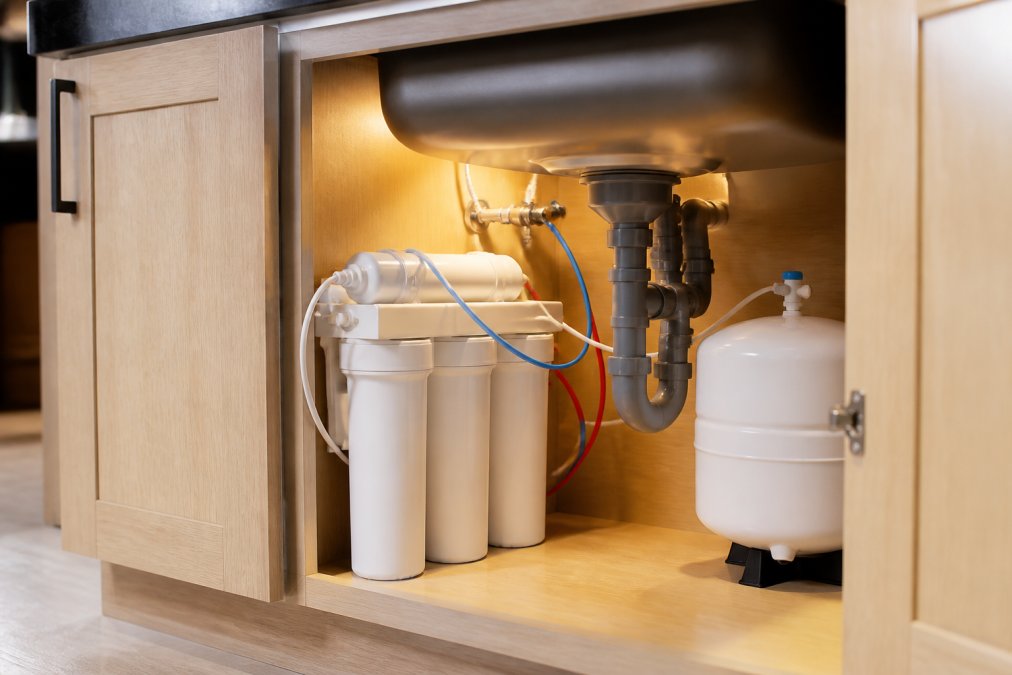
Close-up of an under-sink reverse osmosis unit installed beneath a kitchen sink, with visible filter canisters and clear tubing connected to the water supply line, under warm under-cabinet lighting Reverse Osmosis Systems
Reverse osmosis is the most thorough point-of-use filtration method available for residential use. An RO system forces water through a semipermeable membrane with pores small enough to block dissolved solids, lead, PFAS, nitrates, arsenic, and most volatile organic compounds. Certified systems routinely achieve 95% total dissolved solids reduction.
The tradeoff is waste water. Traditional tank-based RO systems produce between two and four gallons of reject water for every gallon of filtered output. Newer high-efficiency models have improved this ratio, though it remains a consideration in water conservation areas. Under-sink installation is standard, feeding a dedicated faucet at the counter.
RO systems require cartridge replacement on schedule, typically pre-filters every six months and the membrane every two to three years depending on source water quality. Skipping maintenance degrades performance without visible warning.
Best for: Households with confirmed lead, PFAS, arsenic, or high TDS readings from their water quality report.
Activated Carbon Filtration
Activated carbon is the workhorse of residential water filtration. Carbon works through adsorption, binding chlorine, chloramines, volatile organic compounds, and taste- and odor-causing compounds to the filtration media. It does not remove dissolved minerals, nitrates, or heavy metals at meaningful concentrations.
The technology is simple, reliable, and inexpensive to maintain. Countertop units and under-sink cartridge systems both use activated carbon. Many reverse osmosis systems include activated carbon as a pre-filter to protect the RO membrane from chlorine damage.
Carbon filters have finite adsorption capacity. A filter that looks clean can be chemically exhausted. Replacement on schedule matters more than visual inspection.
Whole-House Filtration and Salt-Free Conditioning
Whole-house filtration systems treat water at the point of entry, so every tap, shower, and appliance receives filtered water. These systems typically combine a sediment pre-filter with an activated carbon stage, and sometimes specialty media for contaminants like iron or hydrogen sulfide.
Salt-free conditioning addresses water hardness without adding sodium or producing brine discharge. These systems use template-assisted crystallization to change calcium and magnesium ion structure so they no longer adhere to pipe walls and fixtures. They do not reduce hardness chemically, but scale buildup is dramatically reduced.
Salt-free systems are worth serious consideration for households wanting hard water protection without ongoing salt costs and environmental impact.
Ion Exchange Water Softeners
Ion exchange is the traditional water softening method. The system passes hard water through a resin bed that swaps calcium and magnesium ions for sodium ions, producing genuinely soft water that lathers well and prevents scale buildup.
The ongoing requirement is salt, a typical household softener needs a 40-pound bag every four to six weeks depending on hardness and household size. Some municipalities have restricted salt-based softeners due to brine discharge impact on wastewater treatment, so check local regulations before installation.
Ion exchange softeners require periodic resin bed regeneration and occasional resin replacement. They are not set-and-forget solutions.
NSF Certification Standards for Water Treatment: What the Labels Mean
NSF certification standards are the most reliable independent verification available. The NSF International certification database allows anyone to verify whether a specific product holds claimed certifications.
NSF/ANSI 42 covers aesthetic effects: chlorine reduction, taste, and odor. This baseline certification covers the most common water complaints.
NSF/ANSI 53 covers health effects, including lead and cyst reduction. A system with NSF 53 certification has been independently tested to reduce specific health-related contaminants to EPA maximum contaminant levels.
NSF/ANSI 58 is specific to reverse osmosis systems and covers the full range of contaminants an RO system claims to reduce, including TDS, heavy metals, and nitrates.
NSF/ANSI 401 covers emerging contaminants including pharmaceuticals and certain PFAS compounds. This is the certification to look for if your water quality report shows PFAS detection.
NSF/ANSI 44 covers ion exchange water softeners for hardness reduction.
A common mistake is purchasing a system claiming "NSF-tested" or "NSF-listed components" rather than "NSF-certified." Those phrases do not mean the complete system has been independently verified. The certification must apply to the assembled unit.
Watch Out
PFAS contamination is increasingly detected in water supplies across the country. If your local water quality report shows any PFAS detection, only systems with NSF/ANSI 58 or NSF/ANSI 401 certification for PFAS removal should be considered. Activated carbon alone is not sufficient for all PFAS compounds.Signs You Need a Water Treatment System at Home
Many homeowners wait for obvious problems before investigating water quality, but some serious contaminants are colorless, odorless, and tasteless. Recognizing warning signs early prevents health risks and costly plumbing damage.
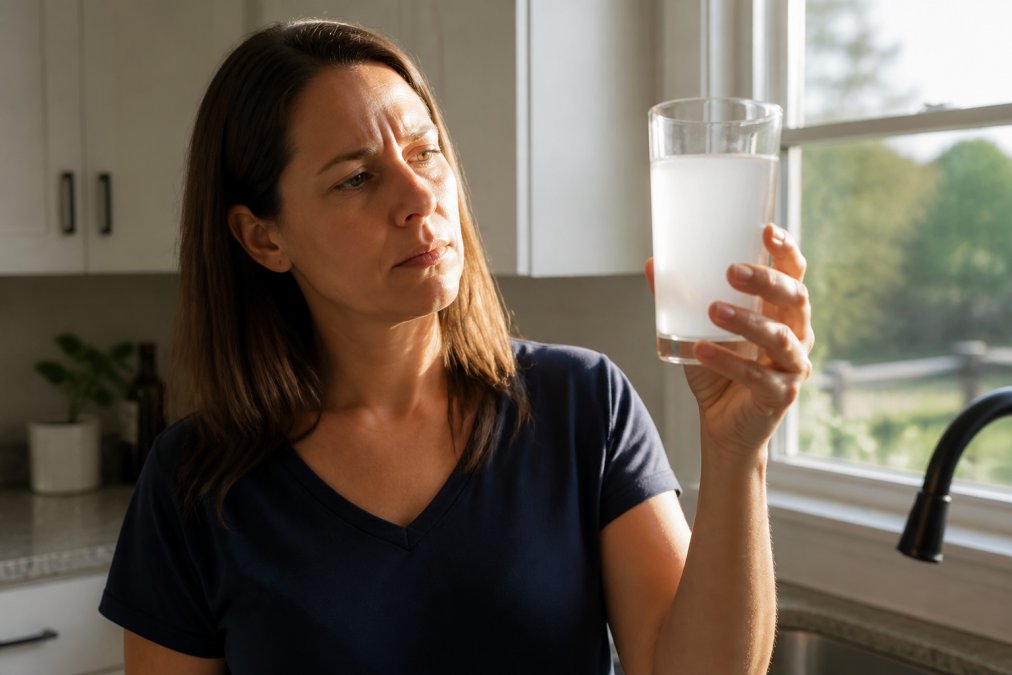
Homeowner holding a glass of cloudy tap water up to natural light near a kitchen window, examining the water quality with a concerned expression, afternoon sunlight streaming through the glass Visible signs are easiest to recognize. White or gray scale deposits on faucets, showerheads, and kettles indicate high water hardness. Orange or reddish staining in toilets, sinks, or laundry points to elevated iron. Cloudy water that clears from the bottom up suggests dissolved air, while persistent cloudiness indicates sediment or bacterial issues.
Sensory signs include a chlorine smell similar to a swimming pool, sulfur or rotten egg odor indicating hydrogen sulfide, and metallic taste often correlating with elevated copper or lead from aging pipes.
Plumbing and appliance signs are often most expensive to ignore. Frequent water heater scale buildup, shortened appliance lifespans, and corroded pipe fittings all indicate water chemistry problems that treatment can address before replacement costs accumulate.
If you recognize any of these signs, the next step is water testing. Many county health departments offer basic testing, and certified laboratories provide comprehensive contaminant panels. Testing before purchasing ensures you treat the actual problem.
Whole House Water Filtration System Cost and Long-Term Value
Whole house water filtration system cost varies considerably based on system complexity, water quality, and installation requirements. What matters more than upfront price is total cost of ownership over five years.
Installation vs. Ongoing Maintenance Costs
Installation costs depend on where the main water line enters the home, whether a bypass valve exists, and local permit requirements. Straightforward installation on an accessible main line takes a few hours. Difficult access, older pipe materials, or pressure regulator upgrades add time and cost.
Ongoing maintenance includes cartridge replacement, salt for softeners, and periodic servicing. These costs are predictable and should factor into the purchase decision. A lower-priced system with expensive proprietary cartridges can easily exceed the five-year cost of a higher-quality system with standard replacement media.
For accurate pricing specific to your home, contact PUR Plumbing. The team has installed and serviced water treatment systems throughout Pasco County for over 25 years and can assess your situation before quoting.
Key Takeaway
The real cost of a water treatment system is not the purchase price. It is the sum of installation, cartridge replacement, salt, servicing, and water damage or appliance replacement costs that a system prevents. Calculate the five-year total, not the sticker price.Post-Installation Water Testing and Verification
Post-installation water testing confirms the system performs as specified. A certified laboratory test conducted 30 days after installation, targeting the same contaminants identified in your pre-purchase test, tells you definitively whether the system works. This is especially critical for reverse osmosis systems, where a damaged membrane can pass contaminants without visible indication.
According to NSF’s guidance on water filter performance verification, consumers should test filtered water periodically rather than relying solely on filter replacement schedules. Water quality can change due to upstream events, seasonal variation, or infrastructure changes.
Keep a simple log: test date, contaminants tested, results, and filter replacement dates. This record is useful documentation if you sell your home.
Regional Water Quality and Smart Home Compatibility
Regional water quality mapping is an underused tool for treatment system decisions. The USGS National Water Quality Assessment data provides detailed mapping of groundwater contaminant patterns by region, giving context that a single household test cannot. Homes drawing from the same aquifer or served by the same utility tend to share contaminant profiles, helping predict what problems may emerge over time.
Fluoride levels, naturally occurring arsenic, agricultural runoff contaminants like nitrates, and legacy industrial contamination all have geographic patterns. A system sized for your region’s typical water profile will outperform a generic selection.
Smart home compatibility is an emerging factor for 2026 buyers. Several manufacturers now offer water treatment systems with Wi-Fi monitoring that tracks filter life, flow rate, and water usage in real time. These systems send alerts when cartridge replacement is due, detect abnormal flow patterns indicating leaks, and integrate with home automation platforms. For households invested in smart home ecosystems, this compatibility simplifies maintenance significantly.
The practical caveat: smart features require reliable Wi-Fi signal near the installation point, often in a utility room or under a cabinet. Confirm connectivity before purchasing.
A water treatment system matching your regional water profile, carrying the right NSF certifications for your specific contaminants, and integrating with how you manage your home will deliver better long-term results than the highest-rated generic product.
Water quality problems range from cosmetic nuisances to genuine health concerns. The right treatment system makes a measurable difference on both fronts. PUR Plumbing has spent over 25 years helping Pasco County homeowners identify their specific water quality issues and install systems that address them. The team is fully licensed, carries certifications CFC 1427929, and arrives with fully loaded vehicles to complete most installations in a single visit. Contact PUR Plumbing to schedule a consultation and get the right water treatment system matched to your home.
Frequently Asked Questions
What is the best water treatment system for a home?
There is no single best water treatment system for every home. The right choice depends on your local water quality report, the contaminants present, and whether you need point-of-use or whole-house coverage. Reverse osmosis handles lead, PFAS, and total dissolved solids effectively. Activated carbon targets chlorine and volatile organic compounds. Start with a water quality test, then match the system to your specific results. A licensed plumber can help you interpret those results and recommend the right fit.
How do I know if I need a water softener or a filtration system?
A water softener addresses water hardness caused by calcium and magnesium using ion exchange, which reduces scale buildup on fixtures and appliances. A filtration system targets contaminants like chlorine, lead, PFAS, and bacteria. If your water leaves white deposits on faucets and feels slippery after softening, hardness is the issue. If it smells like chlorine or tastes off, filtration is the priority. Many homes benefit from both, especially in areas with hard water and older supply lines.
What is the average cost for a whole house water filtration system?
Whole house water filtration system cost varies based on system type, flow rate capacity, number of filter stages, and local installation rates. Basic sediment and carbon systems tend to cost less upfront, while multi-stage systems with UV sterilization or salt-free conditioning cost more. Ongoing expenses include cartridge replacement, annual maintenance, and periodic water testing. Contact a licensed plumber for a quote specific to your home's size, water quality, and plumbing configuration rather than relying on generic averages.
Are professional water treatment installations worth the cost?
Professional installation ensures the system is correctly sized, plumbed to code, and performing as rated. An improperly installed reverse osmosis or whole-house filtration unit can suffer pressure drops, bypass failures, or void the manufacturer warranty. Licensed plumbers also verify flow rate compatibility with your existing water pressure and can conduct post-installation water testing to confirm contaminant reduction. For most homeowners, the cost of professional installation is offset by avoiding early filter failure and the expense of correcting DIY mistakes.
What NSF certifications should I look for on a water filter?
NSF/ANSI Standard 42 covers aesthetic improvements like chlorine reduction and taste. Standard 53 certifies contaminant reduction for health-related concerns including lead and volatile organic compounds. Standard 58 applies to reverse osmosis systems and verifies total dissolved solids reduction. Standard 401 addresses emerging contaminants like PFAS and certain pharmaceuticals. Always check that the certification covers the specific contaminants in your water quality report, since NSF certification is only valid for the contaminants listed on the product's certification scope.
This article was written using GrandRanker
CALL 727-475-1474 and 813-579-1920


CFC 1427929
Serving Pasco County 25+ Years
info@purplumbing.com
Best Water Treatment Systems 2026: A Buyer’s Guide
August 21, 2026 | Blog
- Reageer
For more information or to request an appointment dial 727-475-1474 and 813-579-1920
Serving Pasco County 25+ Years, info@purplumbing.com
Carrollwood
Clearwater
Dunedin
Holiday
Land O Lakes
Lutz
New Port Richey
Oldsmar
Palm Harbor
Plant City
Saint Petersburg
Tampa
Tarpon Springs
Temple Terrace
Town N Country
Trinity
West Chase
Site Designed by GoProLocal