Table of Contents
- Why Small Homes Benefit Most From Tankless Water Heaters
- Tankless Water Heater Installation Cost: What Small Homeowners Should Budget
- How to Choose the Right Size Tankless Water Heater for Your Space
- Continuous Hot Water Without the Tank
- Tankless Water Heater Maintenance Tips for Long-Term Performance
- Total Cost of Ownership: Tankless vs Tank for Small Properties
- Downsides to Know Before You Switch
- Frequently Asked Questions
Last Updated: September 28, 2026
Why Small Homes Benefit Most From Tankless Water Heaters
Key Takeaway
In a small home, the tankless unit’s biggest win isn’t the energy savings. It’s the closet, cabinet, or corner you get back.
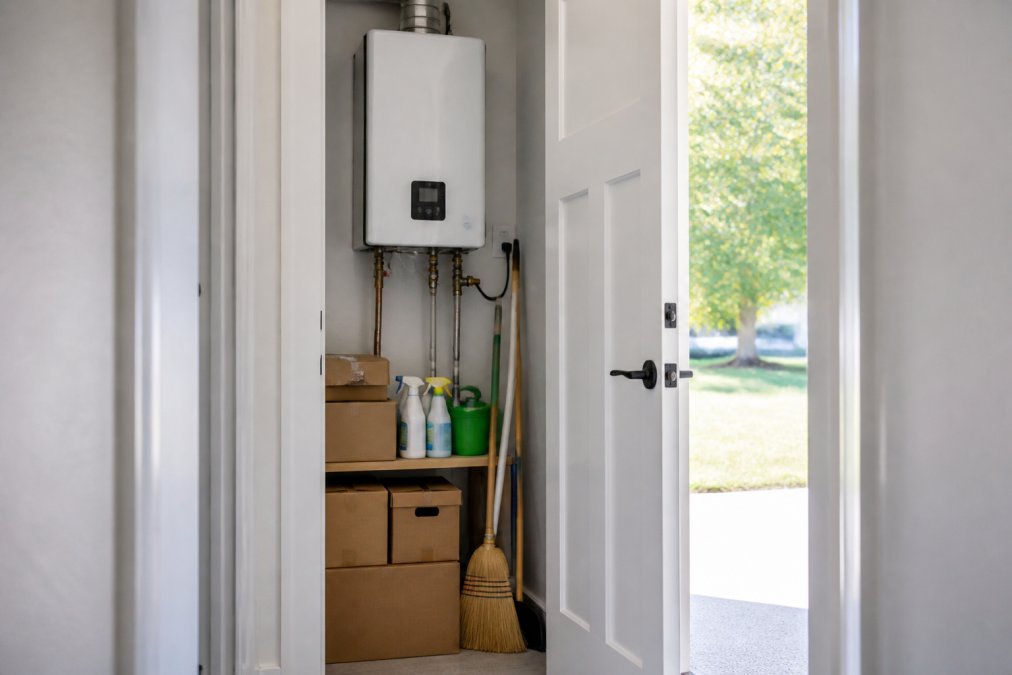
A compact white tankless water heater mounted high on a wall inside a small utility closet, with stacked cardboard boxes, a broom, and cleaning supplies stored underneath it, natural light from an open doorway Space Savings That Matter in Tight Floor Plans
A traditional tank eats roughly the footprint of a small refrigerator, plus clearance for venting and service access, often the only storage closet in a condo or bungalow.
How On-Demand Heating Cuts Standby Heat Loss
Standby heat loss is the energy a tank burns keeping stored water hot around the clock, whether anyone uses it or not. A tankless unit eliminates that loss almost entirely because it only fires when you turn on a tap.
Tankless Water Heater Installation Cost: What Small Homeowners Should Budget
Tankless water heater installation cost depends on the fuel type, the venting route, and how much electrical or gas work your home needs. Any contractor quoting one number over the phone without seeing your setup is guessing. For current pricing, contact our team directly.
Gas vs Electric Installation Considerations
Gas tankless units typically need a larger gas line than a tank used, plus a dedicated vent, often the biggest hidden cost in a retrofit. Electric units avoid venting but usually need a dedicated circuit, and sometimes a panel upgrade.
Factor Gas Tankless Electric Tankless Venting Required None Gas line upgrade Often needed Not applicable Electrical panel Rarely affected Often needs upgrade Best for Homes with existing gas Homes without gas service Retrofitting Challenges in Older Small Homes
Older homes were built around tank systems, and their closets, vents, and gas lines reflect that. Retrofitting a tankless unit into a 1960s bungalow often means running a new vent through an exterior wall or upgrading the gas supply.
How to Choose the Right Size Tankless Water Heater for Your Space
Choosing the right size tankless water heater means matching its flow rate to how many fixtures run at once, not to your square footage. Undersize it and you get a cold-shower penalty the moment someone starts the dishwasher; oversize it and you pay for capacity you’ll never use.
The Fixture GPM Cheat Sheet for Small Homes
Use these typical draws to build your own total. Actual numbers vary by fixture model and water pressure, so treat them as planning figures.
Fixture Typical GPM draw Showerhead (standard) 2.0-2.5 Showerhead (low-flow) 1.5-2.0 Bathroom sink faucet 0.5-1.0 Kitchen faucet 1.0-2.2 Dishwasher 1.0-1.5 Clothes washer (hot fill) 1.5-2.5 Pro Tip
Size for your realistic peak, not your theoretical peak. Most one- and two-bath small homes never run every hot fixture at once, and sizing for that scenario wastes money on capacity you’ll never draw.Temperature Rise: The Number That Changes Everything
Temperature rise is the gap between your incoming groundwater and your target hot water temperature. A unit’s rated GPM is always tied to a specific rise, a unit that delivers 6 GPM at a 45°F rise delivers far less at a 70°F rise.
Sizing Shortcuts by Home Type
If you don’t want to run the full calculation, these starting points cover most small homes. Treat them as a floor, then confirm with a licensed installer.
- Studio or one-bath apartment, one occupant: 3-4 GPM at your local rise is usually enough for a shower plus a sink.
- One-bath home, two occupants: 4-5 GPM covers a shower, sink, and occasional kitchen draw.
- Two-bath home, two to three occupants: 6-8 GPM handles a shower plus laundry or a second shower running together.
- Two-bath home with heavy simultaneous use: consider a larger unit or a point-of-use booster at the far bathroom rather than oversizing the main unit.
Continuous Hot Water Without the Tank
A tank runs out. A tankless unit doesn’t, as long as it’s sized correctly for the fixtures in use. That’s the difference between a 10-minute shower limit and a shower that lasts as long as you want.
Tankless Water Heater Maintenance Tips for Long-Term Performance
Tankless water heater maintenance tips matter more than most owners expect, because scale buildup is the number one killer of these units. In hard-water areas, minerals collect inside the heat exchanger and slowly choke the flow.
- Flush and descale the unit annually in hard-water areas
- Check and clean the inlet filter every few months
- Watch for error codes on the digital display and act on them
- Keep the vent and combustion air intake clear
Watch Out
Skipping annual descaling is the most expensive shortcut you can take. A scaled heat exchanger can fail years early, turning a maintenance call into a full replacement.Total Cost of Ownership: Tankless vs Tank for Small Properties
Total cost of ownership is where the tankless decision gets interesting, because the sticker price is only part of the story. A tankless unit costs more up front, but it usually lasts longer and uses less energy over its life. The gap narrows or widens based on four line items: equipment, installation, maintenance, and energy.
Where the Upfront Money Actually Goes
The equipment premium is real but predictable: a tankless unit typically costs more than a comparable tank at the same capacity, and the gap widens as you move up in GPM. The installation premium is where small-home budgets get surprised. In a retrofit, the added cost usually comes from:
- Gas line upsizing: A gas tankless unit often needs a larger-diameter line than the tank it replaces, which can mean running new pipe from the meter.
- Venting: A tankless unit needs its own vent run, often through an exterior wall, with the correct material for the unit’s category.
- Electrical work: Electric tankless units usually need a dedicated circuit, and sometimes a service panel upgrade if the existing panel is already loaded.
- Combustion air: A gas unit in a sealed closet may need a louvered door or a dedicated air intake to meet code.
- Permits and inspection: Most jurisdictions require a permit for a water heater replacement, and the fee is part of the project.
Maintenance: The Cost Most Owners Underestimate
A tank’s maintenance is close to zero, you replace an anode rod occasionally and that’s about it. A tankless unit needs annual descaling in hard-water areas, plus periodic inlet filter cleaning. That annual service is a real line item, but it’s also what protects the longevity advantage: a scaled heat exchanger can fail years early, turning a maintenance call into a full replacement.
Energy and Lifespan: Where Tankless Earns It Back
Standby heat loss is the energy a tank burns keeping stored water hot around the clock, whether anyone uses it or not. A tankless unit eliminates that loss almost entirely because it only fires when you turn on a tap. For a two-person small home, that’s the biggest ongoing savings.
Cost Factor Tank Tankless Upfront equipment Lower Higher Installation in a retrofit Lower Higher (gas, vent, electrical) Annual maintenance Minimal Annual descaling Standby heat loss Constant Minimal Lifespan Shorter Longer Space used Large footprint Wall-mounted How to Run the Math for Your Own Home
Don’t compare sticker prices. Compare four numbers: your quoted installed price for each option, your estimated annual energy use for each, your expected annual maintenance cost for each, and how long you plan to stay. If you’re staying past the tankless unit’s break-even point, the lifetime math usually favors tankless in a small home. If you’re selling in two years, the upfront premium may not pay back before you move.
Key Takeaway
The tankless decision isn’t “is it cheaper?” It’s “does the lifetime cost beat the tank over the years I’ll actually own it?” Run the four numbers before you sign.U.S. Department of Energy guidance on water heating
Downsides to Know Before You Switch
Tankless systems aren’t the right call for every small home. The upfront cost is real, and retrofit work in an older home can push it higher than expected.
Frequently Asked Questions
What is the downside to tankless water heaters?
The main downsides are higher upfront installation costs and the need for regular maintenance like descaling. Small homes may also face retrofit challenges if the electrical panel or gas line needs upgrading. Tankless units also have a minimum flow rate to activate, so a single low-flow faucet might not trigger heating. Despite these drawbacks, many small homeowners find the long-term savings and space savings outweigh the initial investment.
Do you ever run out of hot water with tankless?
A properly sized tankless water heater provides continuous hot water without running out, as long as the flow rate demand stays within its capacity. In small homes, running a shower and dishwasher simultaneously can exceed the unit’s gallons per minute (GPM) rating, causing temperature fluctuations. Choosing the right size based on your fixture count and incoming water temperature prevents this issue and ensures steady hot water for all your needs.
How much does your electric bill go up with a tankless water heater?
Electric tankless water heaters can draw significant power when active, but they only run when hot water is needed, eliminating standby heat loss. For small homes, this often means lower monthly utility bills compared to tank-style heaters that keep water hot 24/7. Actual savings depend on usage patterns, local electric rates, and the unit’s energy factor. Many homeowners see a reduction, but the exact amount varies by household.
Are tankless water heaters worth the investment for small properties?
For small properties, tankless water heaters are often worth it because they free up valuable square footage, last up to twice as long as tank units, and reduce energy waste from standby heat loss. While the upfront tankless water heater installation cost is higher, the lower utility bills and longer lifespan can offset that over time. Retrofitting in older small homes may add expense, so a professional assessment helps confirm the return on investment.
CALL 727-475-1474 and 813-579-1920


CFC 1427929
Serving Pasco County 25+ Years
info@purplumbing.com
Benefits of Tankless Water Heater for Small Homes
September 29, 2026 | Blog
- Reageer
For more information or to request an appointment dial 727-475-1474 and 813-579-1920
Serving Pasco County 25+ Years, info@purplumbing.com
Carrollwood
Clearwater
Dunedin
Holiday
Land O Lakes
Lutz
New Port Richey
Oldsmar
Palm Harbor
Plant City
Saint Petersburg
Tampa
Tarpon Springs
Temple Terrace
Town N Country
Trinity
West Chase
Site Designed by GoProLocal