Table of Contents
- Average Cost to Repair a Running Toilet: What You’ll Pay in 2026
- What Drives the Price Up or Down
- Toilet Flapper Replacement Cost
- Toilet Fill Valve Replacement Cost
- Running Toilet Water Bill Cost: What That Constant Flow Adds Up To
- DIY Repair vs. Hiring a Plumber for a Running Toilet
- Toilet Repair vs. Replacement Cost: When Fixing Stops Making Sense
- How to Stop a Toilet From Running After Flushing
- Frequently Asked Questions
Last Updated: October 7, 2026
Average Cost to Repair a Running Toilet: What You’ll Pay in 2026
A running toilet is one of the cheapest plumbing problems to fix, and one of the most expensive to ignore. At PUR Plumbing, we’ve serviced homes and businesses across Pasco County for more than 25 years, and most fixes come down to one worn rubber piece inside the tank. Most fixes come down to one worn rubber piece inside the tank.
Here’s the catch: that constant trickle of water keeps charging you every day you wait.
Below, we’ll break down what each repair costs, how much water a running toilet wastes, and when to fix it yourself versus call a licensed plumber.
What Drives the Price Up or Down
The final bill depends on three things: the part that failed, whether you do the work yourself, and how fast you catch the problem.
A simple flapper swap costs far less than a full fill valve replacement. A service call adds labor on top of parts. And a leak that’s been running for months can push your water bill higher than the repair itself.
Here’s what moves the number:
- The failed part – flappers are cheap, fill valves cost a bit more
- DIY vs. pro – labor is the biggest swing factor
- How long it’s been leaking – longer leaks mean higher bills
- Hidden damage – a worn flapper can also wear out the flush valve seat
Most running toilets trace back to rubber parts that wear out with age and water quality.
Toilet Flapper Replacement Cost
A toilet flapper is the rubber seal at the bottom of the tank. It lifts when you flush, then drops back down to stop the water.
When it warps or cracks, water leaks past it and the toilet runs. Flapper replacement is the cheapest running-toilet fix, and it’s the first thing to check.
The flapper itself is a low-cost part at any hardware store. Most homeowners can swap it in under 15 minutes with no tools beyond their hands.
If you hire a plumber, you’re mostly paying for the visit, not the part. That’s why it pays to bundle other small fixes into the same trip.
Pro Tip
Before you buy a new flapper, shut off the water and check the flush valve seat underneath. If it feels rough or gritty, the new flapper will leak too. A light wipe with a cloth often fixes it.Toilet Fill Valve Replacement Cost
The fill valve refills the tank after each flush. When it fails, water keeps running or the tank never fills right.
Fill valve replacement costs more than a flapper because the part is pricier and the job takes longer. Expect 30 to 45 minutes for a careful swap.
Signs you need one:
- The toilet runs constantly, even with a new flapper
- The tank fills slowly or makes a hissing sound
- Water sprays or leaks from the top of the valve
A fill valve is still a budget-friendly part. The real cost is labor if you call a pro.
If your flapper and fill valve are both old, replace them together. You’ll save on a second service call.
Running Toilet Water Bill Cost: What That Constant Flow Adds Up To
A running toilet can waste thousands of gallons of water a month, and the bill usually shows up before the cause does. The exact damage depends on two numbers: how fast the toilet leaks, and what you pay per gallon.
Here’s how to estimate your own cost in about five minutes.
Step 1: Estimate the leak rate. A common way to measure it is the tank-refill test. Mark the water level in the tank with a pencil, shut off the supply valve, wait one hour, then measure how far the level dropped.
Step 2: Convert to a monthly figure. Multiply your daily gallons by 30.
Step 3: Apply your rate. Find the cost per 1,000 gallons on your water bill and divide by 1,000 to get your cost per gallon. Multiply that by your monthly gallons.
A worked example using round numbers: a toilet leaking 3 gallons per hour wastes 72 gallons a day, or about 2,160 gallons a month. At a water rate of $4 per 1,000 gallons, that’s roughly $8.64 a month on water alone.
A slow flapper leak wastes far less than a fill valve that never shuts off, so the range is wide. But even a small constant leak adds up over a full billing cycle, and a badly running toilet can push a single month’s bill into the hundreds.
The EPA’s WaterSense program notes that household leaks waste a huge amount of water nationwide each year, and a running toilet is one of the most common culprits. Many utilities also publish leak-adjustment policies, if you can show a repair receipt, some will credit part of an unusually high bill.
Watch Out
Don’t wait for the next bill to confirm a leak. If you hear water moving when no one has flushed, the toilet is running. Every day you wait adds to your water bill and wears down the internal parts faster.Pro Tip
Snap a photo of your meter reading, wait an hour with no water use in the house, and read it again. If the dial moved, something is leaking, and the toilet is the first place to check.DIY Repair vs. Hiring a Plumber for a Running Toilet
Most running-toilet fixes are DIY-friendly. The parts are cheap, and the job rarely needs special tools.
But DIY isn’t always the right call. Here’s how to decide.
Do it yourself if:
- You’re comfortable shutting off the water supply
- The tank is clean and easy to access
- You’ve identified the part (usually the flapper)
- You have a few hours to spare
Call a licensed plumber if:
- You’ve replaced the flapper and it still runs
- The shut-off valve is stuck or leaking
- You see cracks in the tank or bowl
- The toilet is older and parts are hard to match
- You’d rather not risk water damage
The trade-off is simple. DIY saves on labor but costs your time. A pro saves time and gets it right the first time, which matters when water damage is on the line.
Situation Best Choice Why Worn flapper, easy access DIY Cheap part, quick fix New flapper didn’t stop it Plumber Likely a valve or seat issue Stuck shut-off valve Plumber Risk of flooding Cracked tank or bowl Plumber Needs replacement, not repair Older toilet, odd parts Plumber Right parts, done once At PUR Plumbing, we’re licensed, insured, and family owned, and we carry fully loaded vehicles so most repairs finish in a single visit. You can see our license number, CFC 1427929, right on our site.
Toilet Repair vs. Replacement Cost: When Fixing Stops Making Sense
Repair usually beats replacement, and the math is easy to run once you know what each path actually costs.
What a repair typically includes. A service call usually carries a trip charge, then labor plus the part. A flapper is one of the cheapest parts in the tank; a fill valve costs a bit more; a flush valve (the assembly at the bottom of the tank) is the priciest of the three and the most labor-intensive to swap.
What a replacement typically includes. The toilet itself, a wax ring, a supply line, possibly a new shut-off valve, haul-away of the old unit, and labor to set and seal the new one. Mid-range and high-efficiency models sit in a wide band, and a basic builder-grade unit sits at the low end.
The decision rule. Add up what you’d spend to fix the current toilet, parts plus labor, including any second visit if the first repair doesn’t hold. Compare that to the installed cost of a new toilet.
Replacement also starts to make sense when:
- The tank or bowl is cracked, a cracked tank can’t be repaired safely and has to be replaced
- You’re on your second or third repair on the same unit in a year
- The toilet is an older high-volume model and you want the lower per-flush use of a current WaterSense-labeled unit
- Parts for your model are discontinued or special-order
Repair is the clear winner when a single wear part failed, the porcelain is sound, and the shut-off valve works. That’s the majority of running-toilet calls.
Situation Best Choice Why Worn flapper, easy access DIY Cheap part, quick fix New flapper didn’t stop it Plumber Likely a valve or seat issue Stuck shut-off valve Plumber Risk of flooding Cracked tank or bowl Replacement Can’t be repaired safely Older toilet, odd parts Replacement Right parts, done once Repair estimate near half the installed cost of a new unit Replacement Better long-term value One more factor: a newer WaterSense-labeled toilet uses less water per flush than an older high-volume model, so the savings show up on every bill after the swap. That doesn’t justify replacing a healthy toilet, but it does tip the scale when the old one is already on its way out.
At PUR Plumbing, we’re licensed, insured, and family owned, and we carry fully loaded vehicles so most repairs finish in a single visit. You can see our license number, CFC 1427929, right on our site.
How to Stop a Toilet From Running After Flushing
You can stop most running toilets in under 30 minutes. Here’s the step-by-step process we use.
Total time: 20 to 30 minutes
Difficulty: Beginner to moderateWhat you’ll need:
- Replacement flapper (match your toilet brand)
- Adjustable wrench
- Sponge or towel
- Bucket

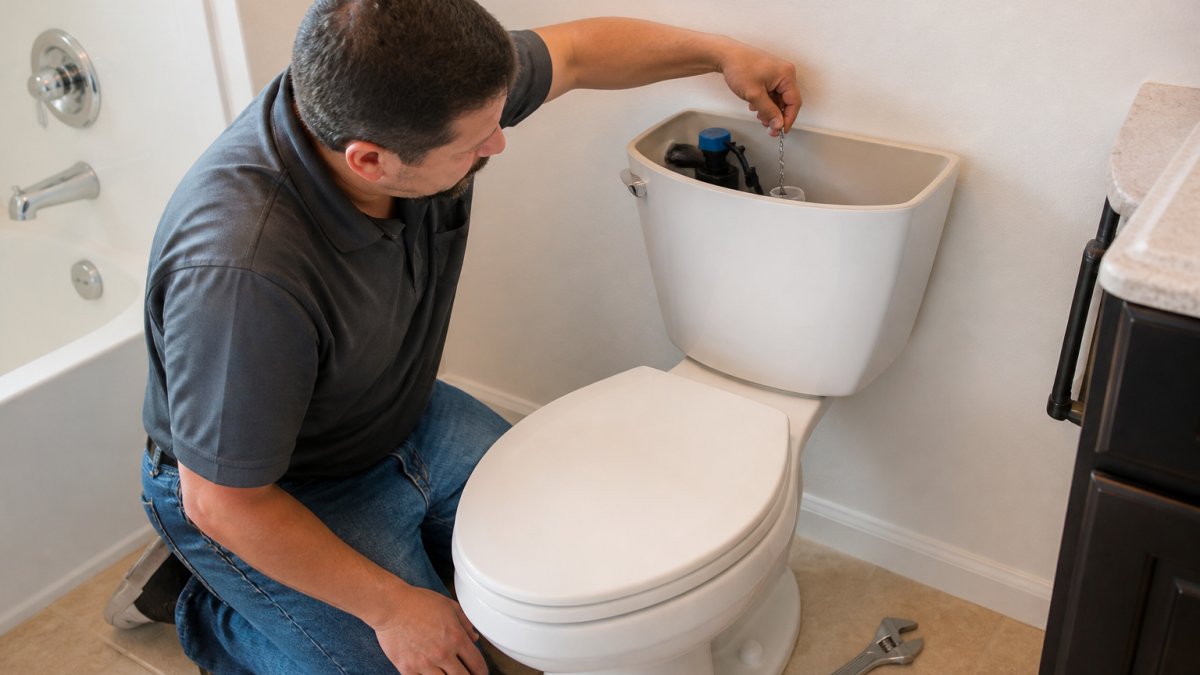
A homeowner kneeling beside a toilet with the tank lid off, one hand lifting the flapper chain while a wrench rests on the floor nearby, bathroom lighting bright and natural Step 1: Shut off the water. Turn the valve behind the toilet clockwise until it stops. Flush once to drain the tank.
Step 2: Inspect the flapper. Lift the flapper and look for warping, cracks, or a mineral film. This is the most common cause.
Step 3: Check the chain. A chain that’s too tight holds the flapper open. A chain that’s too loose catches under it. Aim for a little slack.
Step 4: Replace the flapper if worn. Unhook the old one and clip on the new one. Match the brand for a clean fit.
Step 5: Adjust the fill valve. If the water runs over the overflow tube, lower the float so the tank stops filling sooner.
Step 6: Turn the water back on and test. Let the tank fill, then listen. No sound means you fixed it.
Expected result: The toilet fills, stops, and stays quiet until the next flush.
For official guidance on water efficiency and leak detection, the EPA WaterSense resources are a solid reference.
Key Takeaway
Nine out of ten running toilets come down to the flapper, the chain, or the fill valve. Check those three before you call anyone.A running toilet rarely fixes itself, and every day it runs, it adds to your water bill. If you’ve checked the flapper and it’s still leaking, or you’d rather not risk water damage, PUR Plumbing can help.
Frequently Asked Questions
How much does it cost to repair a running toilet?
Most running toilet repairs depend on the part and whether you hire a plumber. A flapper is often the cheapest fix. For an exact quote in Pasco County, contact PUR Plumbing.
Does a running toilet really increase my water bill?
Yes. A toilet that runs constantly can waste a significant amount of water. The running toilet water bill cost often exceeds the repair itself, which is why fixing it quickly saves money.
Can I fix a running toilet myself?
You can fix many running toilets yourself if the problem is a worn flapper or a misadjusted float. A replacement flapper costs $5 to $15 at a hardware store and takes about 15 minutes to install. Fill valves are slightly more involved but still a DIY-friendly job for most homeowners. If the issue involves the flush valve seat, a cracked tank, or you have already tried a repair that did not work, call a licensed plumber.
How long does it take a plumber to repair a running toilet?
A standard running toilet repair takes 30 to 60 minutes once the plumber arrives. Replacing a flapper or fill valve is quick work. If the flush valve or tank components need attention, it may take closer to 90 minutes. The bigger variable is scheduling: many plumbing companies have same-day or next-day availability for non-emergency repairs, while emergency calls get prioritized. Ask about the service call fee upfront so there are no surprises.
CALL 727-475-1474 and 813-579-1920


CFC 1427929
Serving Pasco County 25+ Years
info@purplumbing.com
Average Cost to Repair a Running Toilet in 2026
October 7, 2026 | Blog
- Reageer
For more information or to request an appointment dial 727-475-1474 and 813-579-1920
Serving Pasco County 25+ Years, info@purplumbing.com
Carrollwood
Clearwater
Dunedin
Holiday
Land O Lakes
Lutz
New Port Richey
Oldsmar
Palm Harbor
Plant City
Saint Petersburg
Tampa
Tarpon Springs
Temple Terrace
Town N Country
Trinity
West Chase
Site Designed by GoProLocal